

Advanced AI Tips for Inspiring Moguls in 2026
How ambitious founders can turn artificial intelligence into a disciplined business advantage without surrendering judgment, ownership, or human authority.
Artificial intelligence has crossed an important line. It no longer functions only as a conversational tool that drafts emails, summarizes documents, or generates social captions.
Current systems can search the web, examine private files, execute code, call business applications, interpret images, maintain working context, and complete multistep assignments.
That expansion creates opportunity, but it also creates a dangerous illusion: access to stronger AI does not automatically produce a stronger company.
Many ambitious entrepreneurs still approach AI through random prompts, disconnected subscriptions, and improvised experiments.
They generate impressive material, yet their pricing remains weak, their customer journey remains disorganized, and their financial records remain unprepared. More technology enters the company while business discipline stays unchanged.
PrimalMogul AI takes the opposite position. Business Intelligence Before Automation means the founder must understand the problem, economics, customer, risk, and desired result before assigning work to a machine.
The governing sequence remains Diagnose → Decide → Delegate. AI serves the person responsible for the decision, never the other way around.
What Are the Best Advanced AI Tips for Inspiring Moguls in 2026?
Advanced AI use in 2026 is not about writing longer prompts or collecting more applications. Inspiring moguls gain an advantage by giving AI verified business context, assigning narrow responsibilities, requiring structured deliverables, testing results against defined standards, and keeping consequential decisions under human control.
The strongest users treat AI as governed executive support rather than an all-knowing authority.
Key Intelligence Takeaways
- Diagnose before assigning work. A machine cannot repair a business problem that has not been correctly identified.
- Context matters more than clever wording. AI performs better when it understands the company, customer, rules, examples, and desired result.
- Outputs should become assets. Every serious interaction should produce a plan, document, analysis, template, dataset, or decision record.
- Agents require boundaries. Tools, permissions, spending limits, approval gates, and stop conditions must be defined before action begins.
- Evaluation is part of production. Reliable AI systems are tested repeatedly rather than trusted because one result looked impressive.
- Human authority remains final. Contracts, financial commitments, compliance decisions, hiring choices, and public claims still require accountable judgment.
AI Has Moved From Conversation to Business Action
By mid-2026, leading AI platforms had expanded far beyond ordinary text generation. OpenAI’s agent infrastructure supports multistep workflows involving web search, file search, code execution, computer environments, reusable skills, and context management.
Google’s Gemini platform supports function calling, structured outputs, search grounding, long-context processing, and real-time voice and visual interaction.
Anthropic has placed growing emphasis on context engineering, agent evaluations, modular skills, and controlled long-running assignments.
- These capabilities change the entrepreneur’s question.
- The old question was, “What can AI write for me?”
- The stronger question is, “Which part of my business process can AI examine, support, or execute under an approved decision structure?”
That distinction separates casual usage from business infrastructure. Writing a sales email is a task. Creating a process that researches prospects, classifies their needs, prepares personalized drafts, records activity, and sends nothing without approval is a system.
Systems create durable value when their inputs, rules, permissions, and measurements are controlled.
The Central Problem: AI Activity Without Business Direction
Entrepreneurs often mistake visible production for commercial progress. Fifty social posts may create activity without attracting qualified buyers. A polished business plan may conceal unsupported financial assumptions. A sophisticated chatbot may answer questions while failing to move visitors toward a purchase.
Three problems usually sit beneath the surface.
First, the company has not identified the precise bottleneck. Is the real problem lead volume, lead quality, weak follow-up, poor positioning, low trust, inconsistent delivery, or an offer that buyers do not value?
Second, AI has been given incomplete context. A generic prompt cannot reliably understand a company’s customer profile, margins, brand standards, legal boundaries, past decisions, or competitive position.
Third, nobody defined what a successful output looks like. Without measurable standards, the founder judges the result by tone or appearance rather than accuracy, usefulness, and commercial impact.
Anthropic’s prompt guidance recommends defining success criteria and establishing a method of empirical testing before refining prompts. That principle matters because prompt wording cannot compensate for an undefined business objective.
1. Begin With a Business Diagnosis, Not an AI Tool
Write the business problem in one sentence before opening any AI platform.
Weak diagnosis:
I need AI to help with marketing.
Stronger diagnosis:
Qualified mortgage prospects are entering our database, but fewer than 20 percent receive a personalized follow-up within 24 hours.
The stronger version identifies a process, affected group, time standard, and measurable failure. AI can now help examine the workflow because the assignment has boundaries.
Ask four questions:
- What result is missing?
- Where does the process fail?
- Which information is required to improve it?
- Which decision must remain human?
This is the practical meaning of Diagnose → Decide → Delegate. Delegation comes last because responsibility cannot be assigned intelligently before the decision has been made.
2. Replace Isolated Prompts With a Business Context Pack
Prompt engineering still matters, but context engineering has become the larger discipline. Anthropic defines context engineering as curating the instructions, tools, external information, conversation history, and working state available to the model during inference.
Create a controlled business context pack containing:
- Company description and business model
- Primary customer and purchasing motivation
- Products, services, pricing, and exclusions
- Brand voice and prohibited claims
- Standard procedures
- Verified performance data
- Approved examples
- Legal and compliance boundaries
- Current priorities
- Required output formats
Do not paste the entire company archive into every conversation. Large context windows can hold extensive material, but capacity does not guarantee relevance. Google advises developers to think carefully about long-context use and how the supplied information affects results.
Provide the smallest collection of verified information that fully supports the assignment. Relevant context improves reasoning. Excess material can bury the facts that matter.
3. Give Every Assignment an Output Contract
An output contract states exactly what the AI must return.
Instead of asking, “Create a customer analysis,” specify:
- Audience
- Objective
- Required evidence
- Analytical categories
- Length
- Tone
- Format
- Exclusions
- Decision criteria
- Uncertainty rules
For repeatable business processes, request structured fields rather than open-ended prose. Structured outputs can force a response into an approved schema, making the information easier to validate, store, compare, or transfer into another application.
Google documents structured JSON responses and function calling as mechanisms for connecting model reasoning to applications and external actions.
A prospect analysis might require fields for industry, company size, stated problem, buying signal, objection, recommended response, confidence level, and supporting evidence. That structure turns a paragraph into usable business data.
4. Assign Different Models to Different Levels of Work
Using the most expensive model for every assignment wastes money. Using a lightweight model for consequential analysis creates a different form of risk.
Create a three-level model policy:
1. Routine work: Classification, formatting, extraction, tagging, basic summaries, and template completion.
2. Judgment-support work: Offer analysis, competitive research, financial scenario review, campaign planning, and customer segmentation.
3. High-consequence work: Contracts, compliance interpretations, credit decisions, public allegations, medical information, tax matters, and investment recommendations.
Routine work can often use faster and less expensive models. Judgment-support work may require stronger reasoning, web access, files, or code execution. High-consequence work should require authoritative sources and qualified professional review.
Model selection should follow the cost of error, not the excitement surrounding a product release.
5. Turn Research Into a Verified Evidence Chain
AI can produce a confident answer from incomplete, outdated, or misunderstood information. Advanced users require an evidence chain.
A strong research assignment should instruct the system to:
- Identify the factual question.
- Search current primary or authoritative sources.
- record publication dates.
- Separate confirmed facts from interpretation.
- Cite evidence beside each important claim.
- State what remains unknown.
- Flag conflicting sources.
- Avoid unsupported precision.
Current web-connected systems can retrieve recent information and attach citations, but search access does not eliminate the need for source judgment.
Anthropic’s web-search documentation, for example, describes real-time access and citations while also using filtering methods to reduce irrelevant material entering the model’s context.
The primal mogul’s job is not to accept every citation. The job is to examine whether the source actually supports the claim.
6. Build Agents Around Narrow Responsibilities
An AI agent combines a model with instructions, tools, memory, and an action loop. Agents can research, manipulate files, call software, update records, or complete extended assignments.
Complexity should still be earned.
Anthropic reports that many successful agent implementations rely on simple, composable patterns rather than complicated frameworks.
Start with one contained responsibility:
- Research five qualified prospects and prepare briefing sheets.
- Review customer-support conversations and classify unresolved issues.
- Compare weekly sales figures against targets and identify material variances.
- Examine a content library and propose internal-link opportunities.
- Convert approved meeting notes into assigned tasks.
Every agent should have defined tools, data boundaries, spending controls, approval requirements, completion criteria, and stop conditions.
OpenAI’s current agent systems use sandboxed environments, tool permissions, context management, and orchestration loops because long-running action requires more control than ordinary conversation.
7. Create Evaluation Sets Before Trusting Repeated Work
One successful response proves very little. Reliable systems are tested against varied cases.
Create an evaluation set containing normal requests, ambiguous requests, missing information, conflicting instructions, sensitive data, unusual customers, and deliberate traps.
Score each result for factual accuracy, instruction compliance, business usefulness, tone, completeness, citation quality, and risk.
Anthropic’s 2026 evaluation guidance explains that agent evaluations help identify failures before they reach production and make behavioral changes visible as systems evolve.
Keep failed examples. They become valuable test cases after instructions or models change.
A prompt should be treated like a business process document. Give it a version number, revision date, owner, test set, and performance record.
8. Use Multimodal AI to Capture the Real Business
Important business information does not exist only in typed documents. It appears in screenshots, voice notes, handwritten plans, dashboards, product photographs, recorded calls, and videos.
Real-time voice and visual systems can support customer assistance, training, translation, product inspection, field documentation, and hands-free business interaction.
Google’s Live API, for example, supports continuous audio, image, and text streams for low-latency voice and visual applications.
A founder working from a phone can photograph a store display, speak observations, compare the image with brand standards, and receive a structured correction list.
A real estate professional can review property photographs while dictating repair notes. A creator can turn spoken ideas into a researched editorial brief.
The advantage is not novelty. It is reducing the distance between real-world observation and structured business action.
9. Protect Data, Permissions, and Human Approval
Agents with access to email, financial documents, customer records, websites, or payment systems create a larger risk surface. Prompt injection, excessive permissions, accidental disclosure, and unintended actions must be considered before access is granted.
OpenAI has described prompt injection as a material risk when agents encounter malicious instructions hidden in webpages or connected data. Its controls include permission requests, active supervision, restricted access, and confirmation before consequential actions.
Use least-privilege access. Give each system only the information and functions required for its assignment. Require approval before sending messages, publishing content, changing records, spending money, signing agreements, or communicating externally.
NIST’s AI Risk Management Framework organizes responsible AI practice around four functions: Govern, Map, Measure, and Manage. The framework helps organizations connect AI use with accountability, risk tolerance, testing, and ongoing supervision.
The Cultural Meaning of AI Ownership
AI access can reduce certain information and production barriers, but it does not erase unequal access to capital, trusted networks, distribution, or institutional influence.
For Black, Latino, Caribbean, immigrant, and first-generation entrepreneurs, that distinction carries economic weight. Communities that create culture have often generated attention for industries they did not own.
AI presents another crossroads: people can become high-volume users of rented technology, or they can use that technology to strengthen customer databases, intellectual property, documented procedures, financial readiness, and owned distribution.
Fast content is not ownership. A viral image is not a customer relationship. An AI-generated plan is not an enforceable agreement.
The most important use of AI may be less visible: converting personal knowledge into documented systems that a company can preserve, teach, measure, and improve.

The Mogul AI Command Stack
PrimalMogul AI’s advanced operating framework contains seven layers:
- Mission: Define the commercial result and responsible decision-maker.
- Context: Supply verified company, customer, process, and policy information.
- Contract: Specify the required format, evidence, boundaries, and success standard.
- Capability: Select the model, tools, files, search access, or code environment required.
- Control: Establish permissions, approval gates, spending limits, and stop conditions.
- Verification: Test facts, calculations, instructions, and edge cases.
- Measurement: Compare time, cost, quality, revenue contribution, and error rates against the previous process.
This structure turns AI from an improvisational assistant into governed business infrastructure.
Common AI Mistakes Moguls Should Avoid
Automating confusion: A broken process performed faster remains broken.
Using one giant prompt: Large instructions become difficult to test, revise, and assign. Divide work into defined stages.
Treating memory as truth: Stored context can become outdated. Review important company facts and policies regularly.
Granting broad access too early: Begin with read-only access and human approval before permitting external actions.
Judging by appearance: Smooth writing can conceal weak evidence, incorrect calculations, or false assumptions.
Measuring output volume: Track qualified leads, response time, conversion, retained customers, cost per completed task, and error reduction.
What This Means for the PrimalMogul AI Reader
- Better judgment: Separate impressive AI demonstrations from systems that solve a verified business problem.
- Stronger ownership: Convert conversations into documented processes, research files, templates, and proprietary knowledge.
- Lower technology risk: Set permissions, reviews, and evidence requirements before AI receives sensitive access.
- Smarter spending: Match model capability and cost to the consequence of the assignment.
- More disciplined execution: Move from scattered prompting into a repeatable command structure.
Understanding AI at this level changes the entrepreneur’s position. You stop asking the machine to impress you and begin requiring it to produce accountable business value.
30-Day Mogul AI Action Plan
- Week 1: Identify one recurring process with a measurable delay, cost, or error.
- Week 2: Create the business context pack, output contract, and three approved examples.
- Week 3: Run the process manually with AI support. Record failures, corrections, time saved, and human decisions.
- Week 4: Build an evaluation set, establish approval gates, and decide whether the process deserves further automation.
Do not expand the system until the first process produces a reliable business asset.
Power Conclusion
AI in 2026 can research, reason, create, communicate, and act across digital environments. Yet capability without command produces expensive confusion.
Inspiring moguls will not win by handing every responsibility to a machine. They will win by understanding their businesses well enough to decide what the machine should know, what it should do, how its work should be tested, and where its authority must end.
Technology can increase the reach of a disciplined founder. It cannot substitute for responsibility.
Frequently Asked Questions
What is the most important advanced AI skill in 2026?
Context engineering is among the most valuable skills. Strong results depend on supplying relevant instructions, company knowledge, tools, examples, working history, and constraints rather than relying on a clever one-line prompt.
Should entrepreneurs create AI agents?
Create an agent when a recurring assignment has stable rules, approved data, measurable success criteria, and clear approval boundaries. Keep the process human-led when the work changes constantly or carries serious legal, financial, or reputational consequences.
Can AI make business decisions independently?
AI can compare evidence, identify patterns, model scenarios, and recommend options. The accountable person should retain authority over contracts, spending, hiring, compliance, financing, public claims, and strategic commitments.
How can a small company evaluate AI results?
Build a test set from real examples. Score outputs for accuracy, completeness, usefulness, formatting, risk, and time saved. Add every meaningful failure to the test set before revising the system.
Is a larger context window always better?
No. Larger context permits more information, but irrelevant or outdated material can weaken results. Curated context is usually more valuable than maximum context.
How should AI-generated research be verified?
Require current sources, publication dates, citations beside claims, and a section identifying uncertainty or disagreement. Open the supporting sources and confirm that they actually support the conclusion.
What should never be fully automated?
Avoid unsupervised automation for financial transfers, contract acceptance, regulatory filings, sensitive communications, medical guidance, legal judgments, employee discipline, or public accusations.
Build Your AI Business Intelligence System
Advanced AI becomes commercially useful when it operates inside a disciplined decision environment.
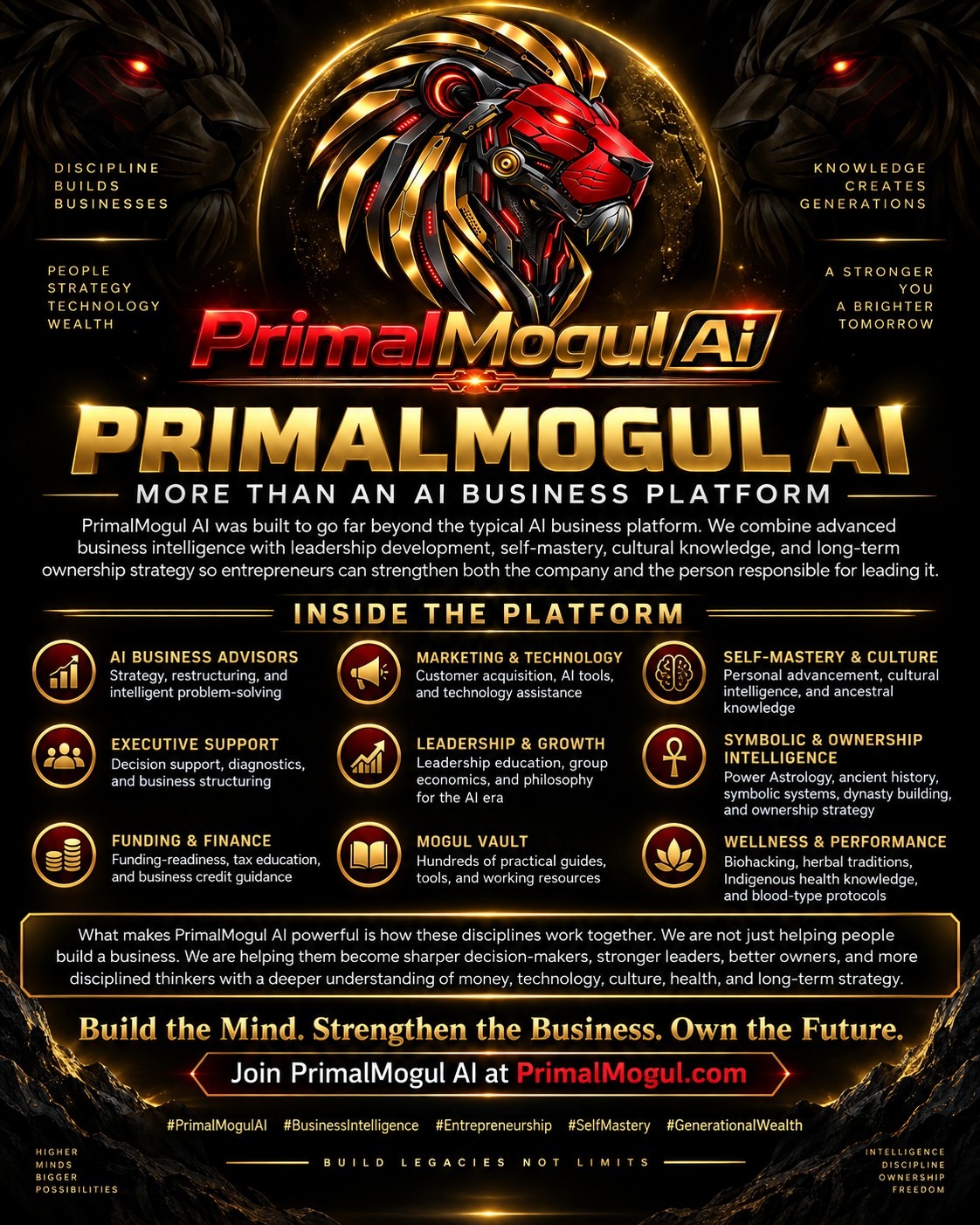
PrimalMogul AI was designed around that principle, giving serious entrepreneurs specialized advisors, structured education, business resources, and controlled pathways for turning intelligence into owned assets.
PrimalMogul AI Elite is the strongest match for readers applying the methods in this article.
- PrimalMogul AI: Examine business models, offers, customers, and strategic priorities before assigning technical work.
- PrimalTech AI: Plan AI workflows, integrations, data structures, and controlled automation.
- Chairman AI: Work through higher-level judgment, responsibility, risk, and leadership decisions.
- Mogul Vault: Access educational resources, frameworks, templates, and implementation guidance.
Elite includes expanded AI capacity, bonus tools, premium resources, and advanced diagnostics for entrepreneurs moving beyond occasional prompting into structured business use. Core Builds. Elite Expands. BoardRoom Commands.
Choose PrimalMogul AI Elite and begin building your business intelligence system.