
How to Start an AI Product Photography Business in 2027 and Sell Monthly Content Packages to Local Brands
Every small brand needs fresh images every month, and most can’t afford a photo shoot. The entrepreneur who solves that with AI, honestly and consistently, builds recurring revenue from day one.
Walk down any commercial street and look at the businesses through a customer’s eyes. The bakery posts the same three blurry cake photos every week.
The skincare brand in the farmers market sells a beautiful product with pictures taken on a kitchen counter. The restaurant’s online menu still shows images from 2021.
None of these owners lack good products. They lack images that sell those products, and the gap gets more expensive every month.
Shoppers judge a business by its pictures before they ever taste, touch or try anything, and AI shopping assistants now read those listings before shoppers do.
That’s the opening for an AI product photography business: a service that turns a business owner’s real products into a steady stream of clean, professional images and content every month, at a price small brands can actually pay.
What Is an AI Product Photography Business?
An AI product photography business photographs a client’s real products. Often with nothing more than a phone and good lighting. Then uses AI image tools to create polished backgrounds, lifestyle scenes, seasonal variations and social media content.
You sell it as a monthly package so the client always has fresh visuals.
It works because three trends are converging:
- AI image tools got good enough for commercial work. Canva launched its own image model on October 22, 2026.
- Shoppers and AI assistants judge products by their images. As covered in our guide to how AI shopping agents choose what to recommend, clear product information wins, and images are part of that information.
- Small brands need volume, not one shoot. Social media, marketplaces and websites demand new content constantly.
Why Now: The Tools Just Changed
On October 22, TechCrunch reported that Canva released Craft, its first in-house image generation model, available to all Canva users through its Dream Lab tab and the Canva API.
Craft plans an image’s layout before rendering it, outputs up to 2K resolution in 30 aspect ratios, and is built to produce legible text. Images can then be converted into editable layers with Canva’s Magic Layers.
That matters for this business for a simple reason. The tools that used to require a design degree and expensive software now sit inside a platform millions of small business owners already know.
The barrier to entry is low, which means the value isn’t the tool. The value is knowing how to use it well, consistently and honestly for a client who has no time to learn.
PrimalMogul analysis:
Low barriers to entry cut both ways. Anyone can generate an image; very few people can deliver a reliable monthly content system that a business can trust.
Build your business on the system, not the software. It’s the same pattern behind the 7 best AI businesses to start in 2027: productized services beat tools.
The Rule That Protects Your Business: Real Product, AI Scene
This is the most important section of the post, and the one most AI photography sellers skip.
Never invent the product. AI should change the setting, lighting and background, not the item being sold. If a client sells a 12-ounce candle in an amber jar, the image must show that exact candle, not an AI’s idea of a nicer one.
There are three reasons this rule is non-negotiable.
Marketplaces require it. Google’s product image requirements say a product image must show the exact item being sold with a clean, unobstructed view.
Google prohibits promotional text, watermarks and added logos on the main image, and requires AI-generated images to keep the embedded metadata that identifies them as AI-generated.
Starting January 31, 2027, Google will require product images of at least 500 by 500 pixels and recommends about 1500 by 1500.
Customers punish misleading images. A dish that looks nothing like the photo, or a product that arrives smaller than pictured, produces returns, refunds and bad reviews. The image you made becomes the reason your client loses money.
Advertising law applies to pictures. Images used to sell a product are advertising, and advertising must not mislead buyers. Food, cosmetics and supplements deserve extra care, and clients in regulated industries should have their marketing reviewed by a qualified professional.
The practical method is simple. Photograph the real product, then use AI to place it in the right scene: a holiday table, a clean studio background, a styled bathroom shelf, a café counter. The product stays real while the presentation gets professional.
How to Start an AI Product Photography Business in 2027
Step 1: Pick a niche you can sell to
Generalists compete on price; specialists compete on results. Start with one category where images directly drive sales and owners feel the pain:
- Beauty and skincare brands that sell online and at markets
- Restaurants, bakeries and food trucks that need menu and delivery-app images
- Boutiques and e-commerce sellers with constant new inventory (see how PrimalMogul supports e-commerce and retail businesses)
Pick the niche you understand best, then learn its visual style deeply. A specialist in food images can charge more than someone who does “a bit of everything.”
Step 2: Build a simple, repeatable kit
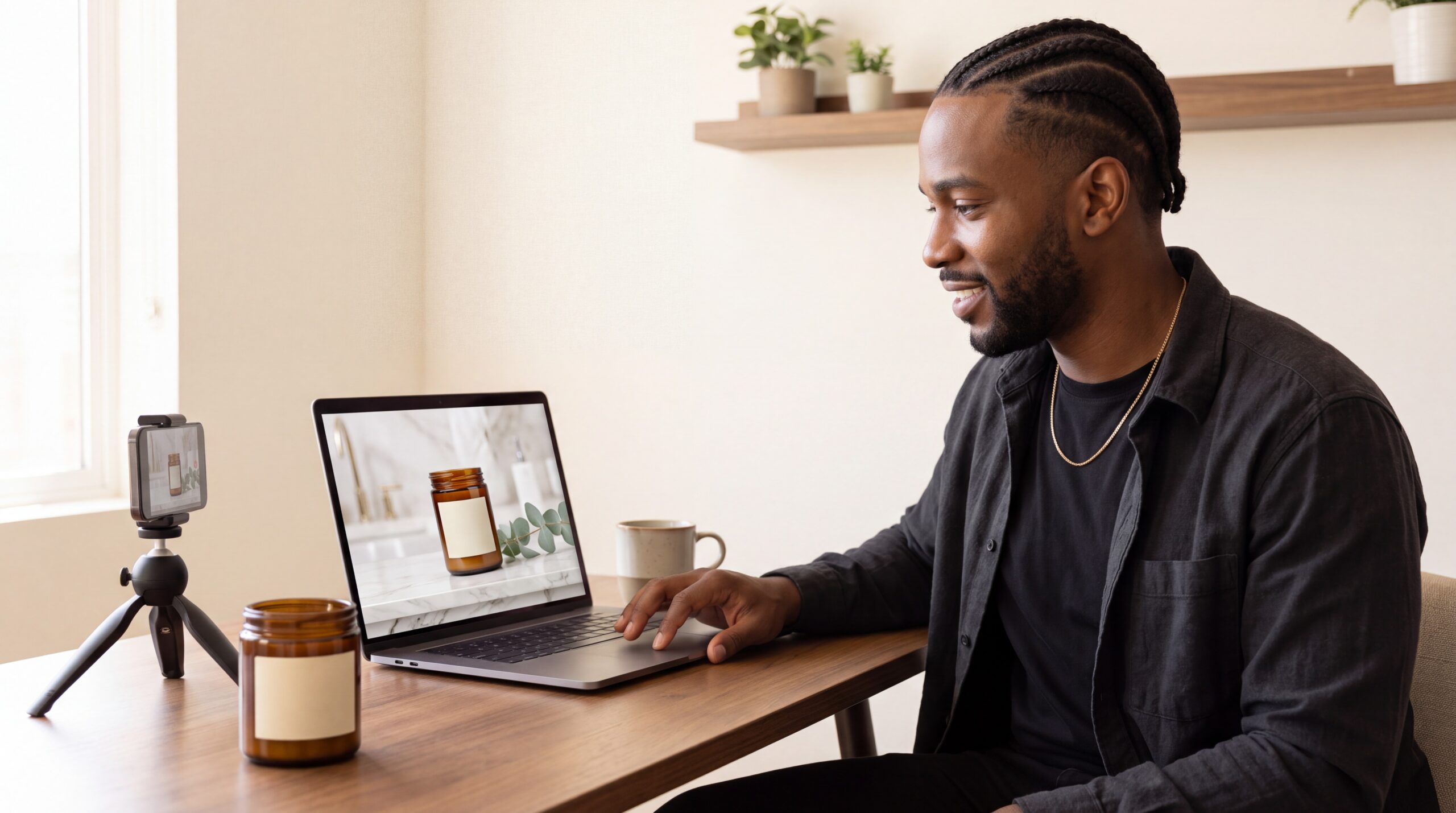
You don’t need a studio to start. A modern phone camera, a tripod, a light tent or two soft lights, and a few neutral backdrops will produce clean source photos. Add your AI image tools (Canva’s Dream Lab and similar platforms) plus a basic photo editor for color and cropping.
The goal is consistency. Clients pay for images that look like they belong to one brand, month after month.
Step 3: Create your portfolio from real products
Ask three local businesses to let you create a free or discounted sample set, or buy a few products yourself and photograph them. Show the before (the phone photo) and the after (the finished scene). A side-by-side comparison sells this service faster than any pitch.
Step 4: Package it as a monthly subscription
One-time photo sessions create a feast-or-famine income. Monthly content packages create predictable revenue. A starting structure might look like this (example only; set prices to your market and costs):
| Package | What the client gets | Best for |
|---|---|---|
| Starter Content | A set number of product images per month in two or three styles | Small brands posting a few times a week |
| Growth Content | More images, seasonal scenes, social-sized versions and marketplace-ready main images | Active e-commerce sellers |
| Brand Studio | Full monthly content calendar: product images, lifestyle scenes, menu updates and promotional graphics | Restaurants and brands posting daily |
Add a one-time Holiday Launch Pack each season. Before Black Friday, it’s the easiest sale you’ll make. For deeper thinking on value-based offers, see the high-ticket AI offer blueprint.
Step 5: Set up the business correctly
Form your entity before you take paying clients. Our guide to starting a business in 2027 with AI: LLC, S-Corp or C-Corp walks through the choice. Use a written service agreement that covers what you deliver each month, revision limits, payment terms, and who owns and may use the images.
That last point needs care. The U.S. Copyright Office concluded in January 2025 that purely AI-generated material is not protected by copyright, and that prompts alone aren’t enough. Protection can apply where a person’s own creative work is visible in the output, or where a person makes creative arrangements or modifications.
Your real product photos and your editing strengthen your client’s position, but don’t promise exclusive copyright on images the AI generated by itself. Spell out usage rights in the contract instead.
Step 6: Sell where your clients already are
Walk into businesses with a before-and-after example of their own product. Run the comparison against their current Instagram or delivery-app listing.
Join local business groups and markets, and offer a free sample image in exchange for an introduction. Then ask every happy client for a referral; small business owners talk to each other.
Common Mistakes That Sink New AI Photography Businesses
Selling the tool instead of the result. Owners don’t care which model you use. They care whether the images bring in customers. Talk about sales, bookings and saved time.
Editing the product itself. Making the burger bigger or the fabric glossier invites refunds, marketplace rejections and complaints. Change the scene, never the product.
Underpricing to win the first clients. Cheap packages attract the clients most likely to leave. Price for the consistency and reliability you deliver.
No system for volume. Ten clients needing 30 images each is 300 images a month. Without templates, a naming system and a monthly calendar, quality slips and deadlines pile up.
Ignoring platform rules. Google, Amazon, Etsy and delivery apps each have image requirements. A beautiful image that gets rejected is worth nothing to the client.
What This Means for the PrimalMogul Reader
- Recurring revenue beats one-time gigs. A monthly content subscription turns creative skill into predictable income.
- Honesty is a business asset. “Real product, AI scene” protects your clients and your reputation at the same time.
- The value is the system, not the software. Tools will keep changing; a reliable monthly process for a niche is what clients keep paying for.
- Local businesses are underserved. Brands without marketing teams are often the most eager buyers and the most loyal clients.
These lessons share one principle: in a market where anyone can generate an image, the business that wins is the one clients can trust every month. That’s Business Intelligence Before Automation applied to a creative service.
Mogul Frequently Asked Questions
What is an AI product photography business?
It’s a service that photographs a client’s real products and uses AI image tools to create professional backgrounds, lifestyle scenes and social content, usually sold as a monthly package.
Do I need professional photography experience to start?
No, but you need an eye for clean, consistent images and a reliable process. A phone, simple lighting, neutral backdrops and AI image tools are enough to build a starter portfolio.
Can I use AI-generated images on Google Shopping and marketplaces?
Often yes, if the image accurately shows the exact product for sale and follows each platform’s rules. Google, for example, requires AI-generated product images to keep the metadata that marks them as AI-generated and prohibits promotional overlays on main images.
Who owns AI-generated product images?
According to the U.S. Copyright Office, purely AI-generated material isn’t protected by copyright, though a person’s creative contributions can be. Define usage rights clearly in your client contract and get legal advice for specific situations.
How do I find my first clients?
Show local business owners a before-and-after of their own product, offer a small sample set, and ask satisfied clients for referrals. Restaurants, boutiques and beauty brands are strong starting niches.
Power Conclusion
Small brands have never needed more images, and they’ve rarely been able to afford them. That gap is the business. AI tools like Canva’s new Craft model make professional visuals possible on a small budget, but tools alone don’t solve the owner’s problem.
A trusted partner who delivers accurate, on-brand content every month does.
Start with one niche, one honest method and one monthly package. Photograph the real product, let AI build the scene, and protect your clients with images that match what they sell.
Do that consistently, and the content studio you start with a phone and a laptop can become a recurring-revenue business that grows with every brand you serve.
Build Your Content Studio With PrimalMogul AI
An AI photography business lives or dies on two things: the quality of the visuals and the strength of the business behind them. PrimalMogul AI is a business and leadership intelligence platform built to support both:
- MogulVision AI: create brand visuals, campaign images and creative direction for your clients inside PrimalMogul’s flagship AI tools. See it in action in how to create your own AI avatar with HeyGen and MogulVision AI.
- The Free Business Power Audit: check your pricing, structure and readiness before you take your first client. Take the free Business Power Audit.
- The BoardRoom Council: pressure-test your packages, pricing and client contracts with six executive seats before you scale. Explore the BoardRoom Council.
Research, Sources and Disclosure
Disclosure: Platform features and image requirements change frequently; confirm each platform’s current rules before delivering client work. Package structures shown are examples, not pricing guidance. Copyright and advertising questions depend on specific facts; consult a qualified attorney for legal advice. This article is educational.