
Your Next Customer Will Ask AI What to Buy. Here’s How to Make Sure It Says Your Name This Holiday Season
AI shopping assistants are becoming the new storefront window. The businesses they recommend are the ones that made their products easy to understand, and that work is also a new business you can start.
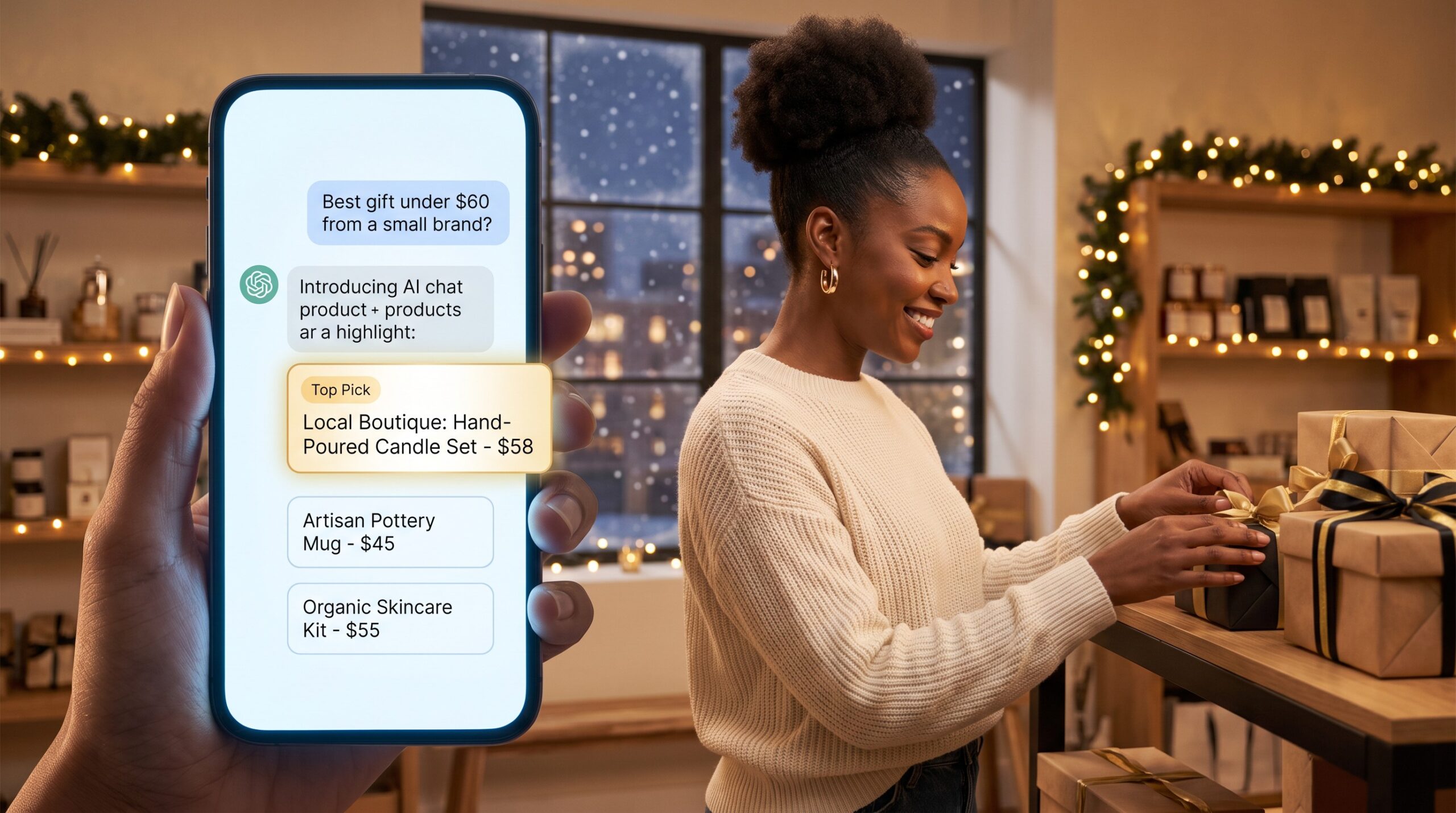
A shopper opens an AI app and types, “I need a gift for my sister who loves natural skincare, under $60, something from a small brand.” Ten seconds later, the AI names three products and explains why each one fits.
If your product wasn’t one of them, you never had a chance. The shopper never saw your website, your Instagram or your window display. The decision happened inside a conversation you weren’t part of.
That is the new reality of AI shopping agents for small business owners, and this holiday season is the first one where it’s mainstream.
According to Shopify’s 2026 holiday report, 65% of shoppers say they will use AI for at least one shopping task this season. The businesses that get recommended won’t always be the biggest. They’ll be the ones AI can understand.
How Do Small Businesses Get Recommended by AI Shopping Agents?
AI shopping assistants recommend products they can read, verify and trust. For a small business, that comes down to three moves:
- Make your product information complete and clear. Plain-language titles, descriptions that name the customer’s problem, and every detail filled in: price, size, materials, shipping and returns.
- Put your products where AI looks. Free product listings in Google Merchant Center, a complete Google Business Profile, and accurate data on your own site.
- Build outside proof. Real reviews, mentions on other trusted sites, and content that answers buyers’ questions, the same signals behind how businesses earn visibility in ChatGPT, Claude and AI search.
None of it requires a big ad budget. It requires organized information, and most small businesses don’t have it organized yet. That gap is also the business opportunity at the end of this post.
Why This Holiday Season Is Different
Shoppers have been using AI to research purchases for a while. What changed is that AI platforms started selling directly.
In September 2025, OpenAI launched Instant Checkout in ChatGPT, starting with Etsy sellers, with Shopify merchants coming next. It also open-sourced the Agentic Commerce Protocol, built with Stripe, so other platforms and merchants could adopt the same buying system.
Google lets merchants show products for free across Search, Maps, YouTube and its Gemini assistant. Shopify now structures its merchants’ product data so AI agents can read it, and connects those products to AI channels.
The numbers from last season show why this matters. According to Adobe data reported by Digital Commerce 360, traffic from generative AI to U.S. retail sites rose 693% during the 2025 holiday season. Shoppers who arrived from AI converted 31% more often than shoppers from other sources.
PrimalMogul AI analysis: that conversion gap is the real story. AI-referred shoppers arrive further along in their decision. The assistant has already answered their questions and narrowed their options. A visit from AI is closer to a walk-in customer holding a recommendation than a casual browser.
How AI Shopping Assistants Decide What to Recommend
Most owners treat AI like a search engine with a chat box. The mechanics are different, and they explain what you need to fix.
It reads structured product data
AI assistants pull from product feeds, store catalogs and structured data on websites. A product listed with a vague title, a missing price or no shipping details is hard for the system to match to a request.
Google’s own requirements for free listings ask for the basics: product ID, title, description, link, image, price and availability, plus shipping settings and a return policy. Missing fields mean missed matches.
It matches problems, not keywords
Shoppers describe what they need in their own words: “a waterproof jacket for walking my dog in Seattle.” Shopify’s report advises merchants to describe customer problems in plain terms for exactly this reason.
A description that only says “Premium Outerwear, Black, M” gives the AI nothing to connect to that request. A description that says who the jacket is for, what weather it handles and why it lasts gives the AI a reason to recommend it.
It looks for trust signals beyond your own site
AI systems weigh what other sources say about you: reviews, articles, local listings and consistent business information across the web.
Shopify’s guidance tells merchants to widen discovery beyond their own site because agents check other authoritative sources. If your business information conflicts from one platform to the next, you look less reliable.
For the wider mechanics of AI search, see our longer study of generative engine optimization.
The 7-Step AI Shopping Visibility Checklist for Small Businesses
Here is the practical version. A small shop can work through most of it in a weekend.
1. Rewrite your top 10 product titles in plain language.
Name the product, the main feature and who it’s for. “Lavender Shea Body Butter for Dry Skin, 8 oz” beats “Calm Collection No. 4.”
2. Write descriptions that answer the buyer’s question.
Cover who it’s for, what problem it solves, what it’s made of, and why it’s worth the price. Shopify’s report found that 35% of shoppers prefer the best version for their needs over the cheapest option, so give the AI a reason to call your product the best fit.
3. Fill in every product detail.
Price, sizes, colors, materials, availability, shipping times and return policy. Blank fields are where AI matches fail.
4. Set up free Google product listings.
Create a Google Merchant Center account and submit your products. Free listings can appear across Google Search, Maps, YouTube and Gemini. Appearance isn’t guaranteed, but you can’t be shown if you’re not listed.
5. Complete your Google Business Profile.
For local shops, the profile is often what AI reads first: hours, location, categories, photos and products. Keep it identical to your website and social profiles.
6. Earn real reviews and outside mentions.
Ask satisfied customers for honest reviews, and pitch local media, gift guides and community blogs. Never buy or write fake reviews. The FTC has a rule against fake reviews and testimonials, and AI systems are built to discount suspicious patterns.
7. Test what AI says about you every month.
Ask ChatGPT, PrimalMogul’s CMO AI and other assistants the questions your customers ask: “best for [need] near [city].” Track whether you appear, then fix what’s missing.
If you sell online, pair this with the systems in how to master AI automation for e-commerce businesses.
Common Mistakes That Keep Small Businesses Invisible to AI
Writing for yourself instead of the buyer.
Clever brand names and inside language read well to you and mean nothing to a shopper’s question. AI matches needs, so describe the need.
Competing only on price.
Shopify’s report warns against defaulting to deeper, earlier discounts, because AI compares prices instantly. Show value beyond price: quality, who the product serves, and what the purchase supports.
Inconsistent business information.
A different address on Google, a different phone number on Facebook and old hours on Yelp tell AI systems your data can’t be trusted.
Treating it as one-time setup.
Products, prices and AI platforms change. Visibility is maintenance, not a single project.
The Business Opportunity: Start an AI Shopping Visibility Service
Every checklist item above is work most small business owners don’t have time to do, or don’t know they need. That makes it a service, and the timing favors whoever starts now.
What you sell:
Getting a business’s products structured, listed and described so AI shopping assistants can understand and recommend them, then keeping that information current.
Who buys:
Boutiques, beauty and skincare brands, gift shops, local food makers, and small e-commerce stores that rely on holiday sales.
How to package it (example structure, priced to your market):
- Visibility Setup: a one-time project covering product rewrites, Merchant Center setup, Business Profile cleanup, consistent listings and a baseline AI visibility test.
- Monthly Visibility Care: new product updates, review requests, monthly AI test reports and listing fixes.
- Holiday Sprint: a fast seasonal package for the top-selling 20 products before Black Friday.
What it costs to start:
A laptop, AI writing and research tools, and a clear process. The skill is organization and judgment, not coding. The hard part is selling, and a before-and-after AI test sells the service for you: show an owner what AI says about them today, then show them who it recommends instead.
Protect the business:
form the right entity before you take clients (start with how to start a business in 2027: LLC, S-Corp or C-Corp).
Use a simple service agreement, and never promise a client that AI will recommend them. No one controls those systems. You can promise the work, the reporting and the improvements.
This fits a pattern we see across AI businesses: niche implementation specialists keep winning while generic AI agencies struggle, as covered in the AI agency gold rush is over. It also pairs naturally with an AI receptionist business, since the same local clients need both.
For more models like this, see the 7 best AI businesses to start in 2027.
What This Means for the PrimalMogul Reader
- The storefront moved. For a growing share of shoppers, the first impression of your business now happens inside an AI conversation.
- Clear information is a competitive edge. Small businesses can win recommendations without big ad budgets if their information is cleaner than their competitors’.
- Value beats discounting. AI compares prices instantly, so the reasons to choose you have to be written down.
- Trust is built off your site. Reviews, listings and mentions matter as much as your own pages.
- Every shift creates a service. The owners who don’t have time to adapt will pay someone who does.
These lessons point the same direction: whether you sell products or sell the service, the winners in AI shopping are the businesses that understand the system before they spend money on it. That’s Business Intelligence Before Automation in practice.
Mogul Frequently Asked Questions
What are AI shopping agents?
AI shopping agents are AI assistants, such as ChatGPT and Google’s Gemini, that help shoppers research, compare and sometimes buy products inside a conversation. They recommend products based on the information they can find and verify.
How can a small business get recommended by ChatGPT or Gemini?
Make product information complete and plainly written, list products in free channels like Google Merchant Center, keep business information consistent everywhere, and earn real reviews and outside mentions.
Do I need a big budget to show up in AI shopping results?
No. Google’s free product listings cost nothing to show, and most of the work is rewriting and organizing information you already have.
Is an AI shopping visibility service a real business?
Yes. Small businesses need help structuring product data, managing listings and tracking AI visibility, and most lack the time. It can be started with low overhead and sold as setup plus monthly maintenance.
Will AI shopping replace my website?
No. AI often sends shoppers to your site or checkout, and Shopify’s data shows that most shoppers still prefer to buy themselves rather than let an agent purchase for them. Your site still closes the sale; AI increasingly decides who gets the visit.
Power Conclusion
The shopper asking AI for a gift recommendation isn’t going to scroll past ten ads to find you. The decision happens in the answer, and the answer goes to businesses whose products are easy to understand and easy to trust.
That’s good news for small businesses. The giants don’t win automatically here. The win goes to whoever has clean product information, consistent listings and real proof from real customers.
Most competitors haven’t done that work yet, and holiday shoppers are already asking.
Start with your own business: run the AI test today and see what it says about you. If the answer is nothing, you’ve found your first project, and possibly your next business.
Build Your AI Visibility Strategy With PrimalMogul AI
Getting recommended by AI is a technical project and a business decision at the same time. PrimalMogul AI is a business and leadership intelligence platform built to help you make both moves with confidence:
- PrimalTech AI: your technical advisor for non-technical entrepreneurs. Map your product data, Merchant Center setup and AI visibility plan step by step, without hiring a developer first.
- The Free Business Power Audit: see where your business is strong and where it’s invisible before the holiday rush. Take the free Business Power Audit.
- The BoardRoom Council: if you’re launching a visibility service, put the offer, pricing and risk in front of six executive seats. Explore the BoardRoom Council.
Research, Sources and Disclosure:
Disclosure: Statistics come from the company and industry sources listed above and reflect their own data. AI platforms change their shopping features often; check each platform’s current requirements before relying on them. Service packages shown are examples, not pricing guidance. No one can guarantee that an AI assistant will recommend a specific business. This article is educational and is not legal or financial advice.