
Black Wall Street’s Real Business Model: What’s Documented, What’s Myth, and What Still Works
Greenwood didn’t need exaggeration to be great. The real record is a sharper business lesson than the legend.
Every year the same post makes the rounds. A dollar in Black Wall Street circulated 36 times before it left the community. Some versions say 100. Today, the post claims, a dollar leaves the Black community in six hours.
It gets shared because it feels true. The problem is that nobody can find the study behind it.
That matters more than most people think. Black Wall Street was real, and Greenwood’s success is well documented.
When a movement is built on a number that can’t be verified, the first skeptic who checks it gets to dismiss the whole story. The real history doesn’t need inflated numbers. It holds a business model that still works, if you study what actually happened instead of what gets repeated.
What Was Black Wall Street’s Real Business Model?
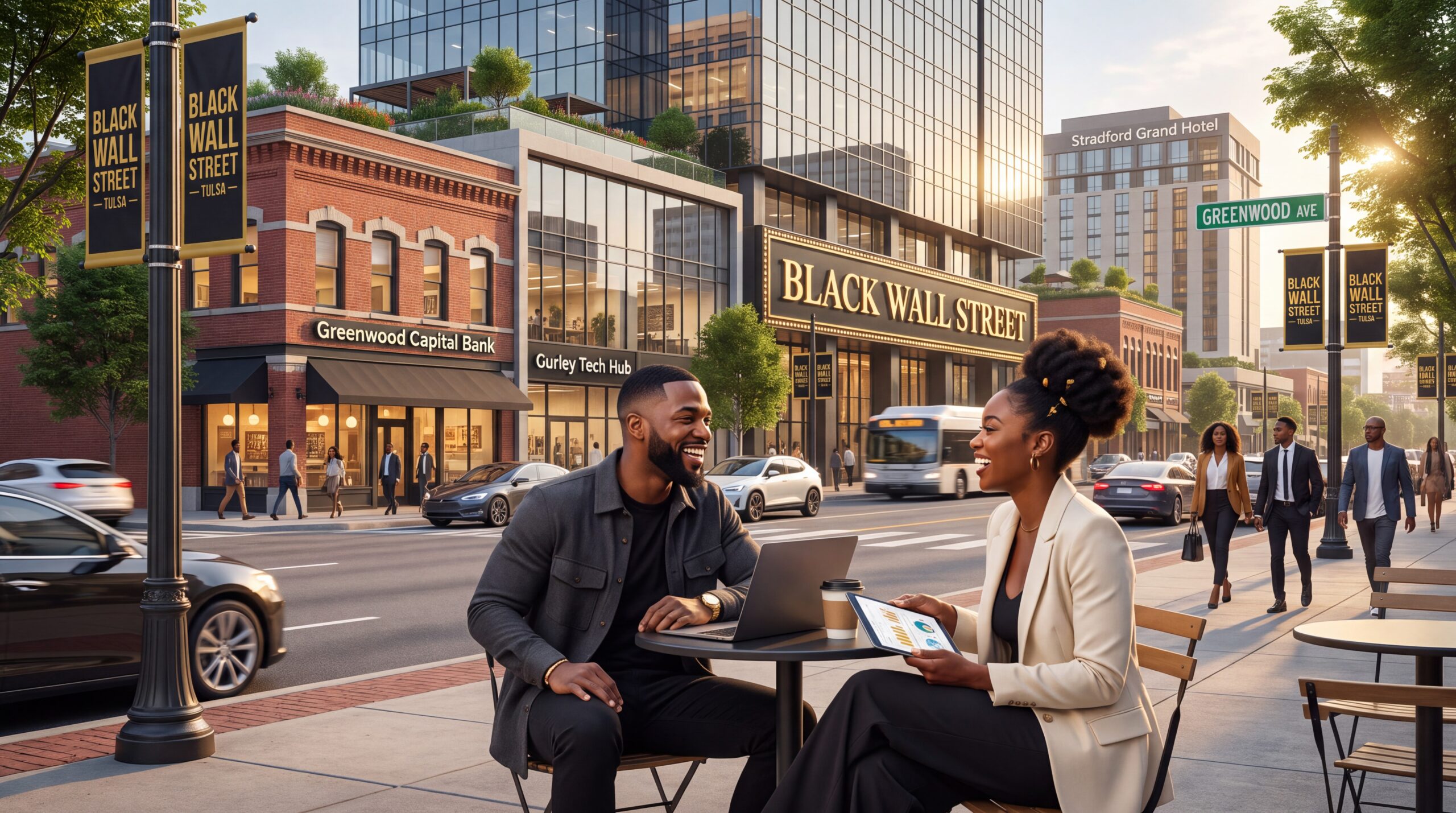
Black Wall Street was the Greenwood District of Tulsa, Oklahoma, home to about 10,000 Black residents by 1921. Its model ran on three engines:
- Income from outside, spending inside. Many residents earned wages in white Tulsa and spent them with Greenwood businesses.
- Ownership of the land itself. Black developers bought land and sold it to Black buyers.
- Insider capital. Local owners lent to aspiring business owners when outside banks would not.
Segregation forced much of that spending to stay inside Greenwood. That made the district strong, and it also left it exposed.
What Black Wall Street Actually Was
Greenwood grew out of the early 1900s, when Tulsa was becoming an oil town. According to History.com’s account of Black Wall Street, O.W. Gurley opened the district’s first business in 1906, a boarding house. He then lent money to residents who wanted to start their own businesses.
The story usually told is that Gurley bought 40 acres and sold parcels only to Black buyers. The deed behind that exact claim is hard to trace in county records, but his role as a builder, landlord and lender is well established.
J.B. Stradford, born into slavery in Kentucky, became a lawyer and one of the district’s major developers. He built the Stradford Hotel, a 55-room property described as the largest Black-owned hotel in the country. He also argued for a principle that is still the center of Black economics: pool resources and Black families have a better chance to progress.
By 1921, Greenwood Avenue and the blocks around it held grocery stores, clothing and jewelry shops, theaters, barbershops and salons, hotels, and the offices of doctors, lawyers and dentists. The district had its own newspaper, the “Tulsa Star”, along with a hospital, a library and a savings and loan.
The nickname has its own history. “Negro Wall Street” is commonly attributed to Booker T. Washington. Survivors interviewed later remembered the “Black Wall Street” name taking hold after the district rebuilt. Either way, the name described a working economy, not a single financial institution.
The Business Model: How Greenwood’s Money Actually Moved
Most retellings stop at “they supported each other.” The real mechanics are more useful.
Engine 1: Outside income, inside spending
Greenwood wasn’t a closed economy. Many residents worked as porters, janitors, dishwashers and domestic workers in white Tulsa. They brought those wages home and spent them inside the district.
This is the part people forget. Greenwood had money coming in from a larger outside economy, plus a reason for that money to stay. Internal spending alone doesn’t create wealth; a closed loop of the same dollars eventually runs dry. Wealth grew because new money kept entering and local businesses captured it.
Engine 2: Owning the ground
Gurley and Stradford built wealth the slowest, surest way: they owned the land other businesses stood on. Stradford bought large tracts, divided them and sold the lots to Black buyers. Gurley accumulated rental property across the district.
When the people doing business also owned the buildings, rent and property value stayed in the community. That’s the lesson behind every successful ownership strategy, from a family duplex to a holding company structure: own the asset, not just the operation.
Engine 3: Building its own capital channel
Mainstream banks weren’t lending to Black entrepreneurs on fair terms, so Greenwood built its own path to capital. Gurley lent to residents who wanted to open businesses, and a local savings and loan held deposits. Capital came from people who knew the borrower, the block and the business.
Today’s equivalents are CDFIs, community banks, credit unions and well-run family lending. If you want the modern version, start with how a family dynasty internal banking system works and how business funding works for Black and Latino entrepreneurs.
The engine nobody likes to name: a forced market
Jim Crow law barred Black residents from many white-owned stores. That segregation is part of why spending stayed inside Greenwood. The district’s customer base was partly captive, and that captive market depended on exclusion.
PrimalMogul analysis: that dependence explains a lot about what happened later. A business model that needs a forced market weakens when the force is removed. Greenwood’s owners built real value, but part of their customer base was held in place by law, not just by loyalty or quality.
Myth vs. Record: What You Can Actually Prove
| Popular claim | What the record shows |
|---|---|
| “A dollar circulated 36 to 100 times in Greenwood.” | No study backs any version of this number. Tellers give different figures (19, 36, 100) because nobody in 1921 measured how many times a dollar changed hands inside a neighborhood. |
| “Today a dollar leaves the Black community in six hours.” | Black Enterprise reported that Howard University researchers could not substantiate it. The figure traces to a personal finance book whose author couldn’t produce the study she cited. Federal data sources don’t measure local circulation at all. |
| “Black Wall Street was destroyed in 1921 and never came back.” | Greenwood rebuilt within years and prospered for decades. Its second decline came later, through highways, urban renewal and changing markets. |
| “Greenwood was a separate Black city.” | It was a district inside Tulsa, which is exactly why white city government could rezone it, deny its claims and later route a highway through it. |
| “Every dollar stayed in the community.” | Much of Greenwood’s money came from wages earned in white Tulsa. That outside income was a feature of the model, not a weakness. |
Why the myths hurt: an unverifiable number does more damage than a smaller true one. A real lesson (“bring money in, own the asset, build your own capital”) survives scrutiny. A fake statistic gets debunked, and the lesson gets thrown out along with it.
The Two Destructions of Black Wall Street
1921: the massacre
On May 31 and June 1, 1921, a white mob attacked and burned Greenwood. Early official counts were far lower than later estimates. Red Cross relief leader Maurice Willows reported about 300 deaths, and the true number is still debated. According to Smithsonian Magazine’s account of Greenwood’s second destruction, 1,256 homes were destroyed across more than 35 blocks.
Then the financial system finished what the fire started. Between June 1921 and June 1922, residents filed an estimated $1.5 million to $1.8 million in claims against the city, and most were disallowed, according to the Tulsa City-County Library. Insurers refused to pay. Within a week of the attack, the city rezoned Greenwood for industrial use and imposed costly new fire-code rules that made rebuilding harder.
Greenwood fought back in court. Attorney B.C. Franklin sued the city and won, blocking the scheme. By December 1921, 764 of the 1,256 destroyed homes were already being rebuilt.
That’s the part of the story that deserves to be repeated: the same families who lost everything rebuilt without insurance payouts, without city help and against hostile zoning.
The 1950s–1970s: the slow destruction
Greenwood came back. NBC News reported that by the 1950s and 1960s, Black owners ran about 40 grocery stores and dozens of confectioneries in the district.
The second decline came through policy and markets rather than fire. Redlining began in the 1930s. Tulsa’s 1957 comprehensive plan called for an inner highway loop. Interstate 244 and U.S. 75 cut through Greenwood, and the loop was completed in 1971.
Residents like Mabel Little lost rebuilt homes and businesses to eminent domain, often compensated, the Smithsonian notes, “far below market rate.”
PrimalMogul analysis: desegregation also changed the math. Once Black customers could legally shop anywhere, many did. The forced market that had held spending inside Greenwood disappeared, and businesses that had depended on it now had to compete for customers. Some could; many couldn’t.
What Still Works in 2027
Greenwood’s model, taken apart and rebuilt for today, comes down to five moves.
1. Bring money in from outside. Greenwood’s wealth grew because outside wages flowed in. For a modern business, that means selling beyond your block: online, to other regions, to corporations and government contracts. Local loyalty is a base, not a ceiling.
2. Own the ground. Real estate, intellectual property, equipment and equity are the modern versions of Gurley’s lots. If you run the business but don’t own anything it stands on, you’re the tenant, not the landlord.
3. Build your own capital channel. Greenwood lent to its own because outside capital was closed. Today, fundable business credit, CDFIs and structured family lending play that role. A clean credit file is your savings and loan. Before you apply, know what lenders look for before they fund your business.
4. Protect the asset before you need to. Greenwood’s claims were denied and its insurance didn’t pay. The modern defense is structure: the right entities, real insurance, clean documentation and contracts reviewed by qualified professionals. Ownership without protection is exposure.
5. Treat circulation as a strategy, not a slogan. Black businesses buying from other Black businesses (suppliers, contractors, professional services) builds real value when it’s based on quality and price. Measure it in your own books instead of quoting someone else’s unverifiable statistic.
The numbers show both progress and the size of the gap. According to Brookings research on Black employer businesses, Black-owned employer businesses passed 200,000 for the first time in 2023, generating $249 billion in revenue and supporting more than 1.8 million jobs.
Black Americans still made up just 3.4% of employer business owners while representing 14.4% of the population. The opportunity is in closing that gap.
What This Means for the PrimalMogul Reader
- Your story needs receipts. Facts you can prove make you more credible than slogans someone can debunk. That goes for your marketing, your pitch deck and your history.
- Income that comes from outside your community builds the most wealth. A business that only sells to its own neighborhood has a ceiling.
- Ownership is the multiplier. Revenue pays the bills; owned assets build generational wealth.
- Structure is protection. Greenwood shows what happens to wealth without legal and insurance protection.
- Know your market’s foundation. If your customers stay only because they have no alternative, plan for the day they do.
Taken together, these lessons describe one discipline: build wealth that would survive a test. Greenwood’s owners had the vision and the work ethic.
What they lacked was protection from systems that refused to honor their claims. Modern entrepreneurs have tools Greenwood never had, and the responsibility to use them.
Mogul Frequently Asked Questions
What was Black Wall Street?
Black Wall Street was the Greenwood District of Tulsa, Oklahoma, a thriving Black business community of about 10,000 residents by 1921. It was known for Black-owned stores, hotels, theaters, professional offices and its own newspaper.
Did a dollar really circulate 36 to 100 times on Black Wall Street?
There’s no verifiable study behind that claim. Different sources give different numbers, and no one measured local money circulation in 1921. Greenwood’s success is documented without it.
Who founded Black Wall Street?
No single person founded it, but O.W. Gurley and J.B. Stradford were central developers. Both bought land, sold or rented it to Black residents, and helped finance businesses in the district.
What destroyed Black Wall Street?
Greenwood was devastated twice: first by the 1921 massacre, then decades later by redlining, urban renewal and highway construction, including Interstate 244. It also lost its captive customer base after desegregation.
Can the Black Wall Street model work today?
Its core principles still work: bring outside income in, own assets, build your own capital access and protect what you own with proper structure. They work best when combined with modern credit, legal entities and access to markets beyond one neighborhood.
Power Conclusion
The real story of Black Wall Street is stronger than the myth. A neighborhood that started with boarding houses and land deals became one of the most successful Black business districts in American history, rebuilt itself after a massacre without insurance payouts, and prospered for decades more.
The raw lesson is that wealth comes from bringing money in, owning what it lands on, controlling your own capital and protecting all of it with structure. Greenwood proved the model. The tools to run it now are better than anything Gurley or Stradford ever had.
The next move is to apply it to your own business, starting with an honest look at where you stand today.
Build the Next Greenwood With PrimalMogul AI
Greenwood’s builders studied ownership, capital and protection because they had no other choice. PrimalMogul AI is a business and leadership intelligence platform built to put that same discipline behind your business:
- PrimalMoor AI: your ancestral economic strategy advisor. It connects the history of Black economic power, from the Moors to Greenwood, to the ownership, capital and family-wealth decisions in front of you now.
- The Free Business Power Audit: a no-cost diagnostic that shows where your business is strong and where it’s exposed. Take the free Business Power Audit before your next major move.
- The New Black Wall Street: Sultan’s book on ownership, capital and power for the next generation of Black entrepreneurs. Get The New Black Wall Street: Sovereign Power, Wealth and Ownership for Black America.
When you’re ready to bring a major decision before six AI executive advisors, the BoardRoom Council membership tier is built for exactly that.
For where Greenwood stands today, see Black Wall Street: Tulsa’s $105 Million Reparations Move.
Research, Sources and Disclosure:
Disclosure: Death tolls, property figures and some founding details from 1921 vary between sources; where accounts differ, this post states the range or the source. Sections labeled “PrimalMogul analysis” are interpretation, not established fact. This article is educational and is not legal, tax or investment advice.