

How to Run an AI Business: The Montezuma Blueprint for Solo Founders
Running a successful AI business comes down to four structures working as one: a decision-making layer that separates judgment from execution, multiple revenue lanes that support each other, operational discipline that scales with your readiness, and real skill-building instead of passive learning.
Founders who build these four outlast the ones who simply collect AI tools and hope. This guide teaches each structure using one of history’s most effective command systems, then shows you the platform that turns the blueprint into a working business.
You most likely searched for how to run an AI business
If you searched for how to run an AI business, you have already hit the same wall everyone hits. There is endless advice about which AI tools to use, which prompts to copy, and which trends to chase.
There is almost nothing about how to make those tools work together as one functioning company. That gap is where most solo AI ventures quietly fall apart.
Here is the raw truth that changes everything: AI tools do not build companies. Structure does. You can own the most advanced AI software on the market and still lose, the same way a skilled craftsman with the finest instruments still fails without a blueprint.
What you actually need is a operating system that organizes decision-making, revenue, discipline, and training into something that holds together under pressure.
To teach that system with precision, this guide uses an unexpected model: the governance architecture of the Aztec Empire under Montezuma II. He ran a coordinated operation of 200,000 people through structure rather than force.
The principles that made his command work translate with surprising accuracy onto a modern one-person AI business. By the end, you will know how to build each one, and where to go if you want it already assembled.
Why a Solo AI Business Needs Structure More Than Tools
Most founders building an AI business start backwards. They begin with the software, accumulate more software, and then wonder why nothing connects. The missing layer is structure, the framework that tells each piece what to do and when.
Think about the challenge you actually face. You are coordinating many moving parts toward one outcome, under time pressure, usually alone. That is the exact challenge any large organization faces, only compressed into one person.
The operations that solve it well rely on systems, not extra effort, because nobody can personally out-work a disorganized business for long.
Effective governance throughout history has relied on four operating systems, and they map cleanly onto your venture:
- Decision-making determines who decides what, and in what order.
- Economics determines how money flows in and stays stable when one source slows.
- Discipline determines how the operation advances without breaking.
- Education determines how a beginner becomes a capable operator.
Build these four well, and your business runs even on days when your energy is low. Build them poorly, and no amount of hustle will hold it together.
Each section below takes one system, shows how the empire built it, then hands you the practical modern version you can stand up this week.
Key Takeaway:
Stop asking which AI tool to buy next. Start asking which of your four operating systems is weakest, then strengthen that one first. Business Intelligence Before Automation.
How to Structure Decision-Making in Your AI Business
Separate the part of your business that decides from the part that produces. When strategy and execution blur together, the business drifts. A decision layer that diagnoses problems before you act keeps every move deliberate instead of reactive.
The Principle: Preparation Before Power
The most overlooked leadership lesson in the Aztec model is sequence. Montezuma did not rise to power as a politician. He trained for years as a high priest, studying astronomy, mathematics, law, and the interpretation of incoming information, all before he ever issued a single command. Preparation came first. Authority came second.
His government reflected the same order. At the top sat a small group holding strategic authority over the major decisions. Below them, an administrative layer managed the machinery.
Below that, operators executed daily work. Every layer held defined authority and a defined lane. No one decided above their level, and no one skipped the sequence from diagnosis to action.
The Problem: Solo Founders Collapse the Layers
Here is where the solo founder breaks down. You wear every hat at once, which means you make high-level strategic calls in the same exhausted moment you are producing the work.
Strategy and execution collapse into one blurred activity, and the business loses direction because nobody is sitting in the decision seat with a clear head.
The fix is a decision layer that operates separately from your production work. In practical terms, that means a structured way to diagnose a problem, decide the strongest response, and only then move into building.
On PrimalMogul AI, that layer is the BoardRoom Council, a set of specialized AI advisors that each hold one domain of business judgment:
- Chairman AI carries strategic oversight and long-range judgment.
- CEO AI turns scattered ambition into business structure and launch priorities.
- CFO AI governs pricing, funding readiness, and cash flow before a dollar moves.
- CMO AI directs brand positioning and customer acquisition.
- CTO AI maps automation readiness and technical risk.
- Chief Compliance Officer AI guards against reckless promises and documentation gaps.
None of these advisors does the execution work. Their entire purpose is to sharpen the decision before production begins, the same way Montezuma kept his counsel separated by function so that no single voice ran the whole empire.
The doctrine is simple: Diagnose. Decide. Delegate.
Key Takeaway:
Before building anything, name which kind of decision you are facing. Money decisions, structure decisions, and judgment decisions each deserve focused thought on their own terms.
Routing a problem to the right analysis first is what turns guesswork into command. The machine is staff, never sovereign.
How to Build a Revenue Architecture That Does Not Collapse
Build at least two revenue lanes that support each other, then add a retention layer that holds customers between purchases.
Recurring income gives you stability, product sales give you velocity, and a strong value reserve gives you loyalty. No single source should ever carry your whole business.
The Principle: Two Systems That Feed Each Other
Tenochtitlan ran a hybrid economy most founders never think to study. Mandatory tribute flowed from over 400 conquered city-states into imperial storehouses on a regular schedule.
Alongside it operated the Tlatelolco marketplace, where as many as 60,000 merchants transacted daily in a regulated free market.
These two systems did not compete. When one slowed, the other carried the load, which is exactly why the economy stayed stable across decades.
Wealth from the steady lane was then redistributed to keep the whole system moving. No single point of revenue carried the entire weight of the operation, and that distribution is what made it durable.
The Problem: Single-Lane AI Businesses Are Fragile
Most new AI businesses lean on one income source: a single service, a single product, or a single client. When that source slows, and every source eventually slows, the whole business wobbles. Fragility is built into a one-lane model from the start.
Your business needs the same resilience, plus a third layer that holds people between purchases. On PrimalMogul AI, the architecture maps directly:
- Digital product sales function as the marketplace, capturing buyers at every price point.
- PrimalWealth AI and the Mogul Funding Roadmap function as your financial intelligence, giving you a clear capital position before any spend.
Why Reliability Beats Promotion
Montezuma’s temples doubled as emergency food banks during crop failures, feeding the public when harvests collapsed. That single act of reliability earned deeper loyalty than any military victory.
Structure before scale. The empire never expanded before its storehouses were full.
Key Takeaway:
Stop relying on one income source. Build at least two lanes that feed each other, then add a value reserve that retains everyone who enters. Know your true financial position before you spend a dollar on growth.
How to Scale Operations Without Breaking
Reward composure over speed, and match responsibility to demonstrated readiness. The strongest operators are not the fastest. They are the ones who stay steady under pressure and take on more only after they have earned it.
The Principle: Control Over Chaos
The Aztec warrior did not earn rank through raw aggression. To advance, a soldier had to capture enemy warriors alive, which demanded precision and self-control under combat conditions. Killing was common. Capturing required discipline.
The military valued the controlled operator over the violent one, and that standard shaped who eventually advised the emperor.
Montezuma’s Council of Four were not agreeable subordinates. These were generals who had survived real campaigns and earned their seats through performance.
Their job was never to flatter. Delivering the most accurate picture of reality before resources moved was their actual function.
The Problem: Founders Outrun Their Own Readiness
A common failure is moving faster than your foundation can support. Founders scale spending, commitments, or complexity before they have the maturity to handle it, and growth that arrives before readiness breaks the business instead of building it.
The fix is to grow in stages matched to your real capacity. PrimalMogul AI structures this through three membership tiers, each reflecting a stage of operational maturity rather than just a price:
- Core Tier: activates the builder with the foundational system: seven flagship AI tools, full Vault access, and 150,000 AI words per month. Core Builds.
- Elite Tier: expands capacity with 300,000 AI words, bonus tools, and advanced templates. Elite Expands.
- BoardRoom Council: delivers the command layer: 1,000,000 AI words, the private BoardRoom Command Center, and the full Executive AI Council. BoardRoom Commands.
Core is the trained soldier entering the field with real equipment. Elite is the warrior who earned promotion. BoardRoom is the seat at the war council table, where members direct the tools rather than learn what they are.
Key Takeaway:
Match your stage to your actual readiness, not your ambition. Build a solid foundation first, expand once it holds, and take on full strategic complexity only when the cost of a wrong decision is high enough to demand it. Discipline creates freedom.

How to Train Yourself Into a Capable AI Business Owner
Treat your education as formation, not entertainment. Information alone produces confident mistakes. Real training forces you to produce a tangible output every time you learn, which is how raw knowledge becomes operator-level skill.
The Principle: Knowledge Without Formation Fails
The Calmecac was not a school in any modern sense. Students were awakened at midnight for study, performed hard labor despite noble backgrounds, and proved that comfort would never govern their decisions.
The curriculum ran from astronomy to law to sacred calendar reading. Advancement never came on a fixed schedule. Promotion came when demonstrated competence earned it.
The principle behind that rigor matters for you directly: knowledge without formation produces intelligent failures. You can study every marketing tactic and still lack the judgment to know when not to run a campaign.
You can memorize financial frameworks and still freeze under your first real cash crunch. Information is not capability.
The Problem: Passive Consumption Feels Like Progress
Most people learning to run an AI business consume endlessly. They read, watch, and bookmark, mistaking consumption for momentum. Months pass, and they know more without being able to do more, because passive intake never builds operational skill.
Real training closes that gap by demanding output. On PrimalMogul AI, your development moves through specific stages designed to make you produce:
- The Mogul Business Diagnostic, a 25-question scan, works as the assessment that determines whether you are ready for advanced instruction.
- The 7-Day Activation Path moves you from orientation toward your first real business output.
- PrimalCourses AI turns knowledge into demonstrated skill through modules, assignments, and implementation gates.
A founder who reads every resource without ever running a diagnostic, building an offer, or mapping a workflow is the Calmecac student who memorized the codices but never performed the work. That student never advanced, and neither will that founder.
Key Takeaway:
Treat your education as formation, not entertainment. After every learning session, produce one tangible output: a diagnostic, a draft offer, a mapped workflow. Implementation over information.
How to Replace Guesswork With Real Business Intelligence
Build a operating system that feeds you accurate intelligence before every major decision. Most founders decide on impulse and trends. The ones who win consult specialized AI intelligence first, then act.
The Principle: Good Decisions Need Good Inputs
Montezuma maintained a specialized faction dedicated to reading intelligence: events, reports, and incoming information analyzed before any major move.
He required detailed intelligence before committing to a campaign because everyone understood that weak inputs lead directly to weak decisions, no matter how strong the leader.
The Problem: Most Decisions Run on Trends
Most entrepreneurs operate with almost no real intelligence layer. Major decisions get made on trending posts, half-finished research, and whatever advice was heard most recently. Weak inputs reliably produce weak outcomes, multiplied across every decision you make.
Building an intelligence layer means having focused analysis for each part of your business rather than one general source stretched across everything. On PrimalMogul AI, this takes the form of seven specialized tools, each holding a defined scope:
- PrimalMogul AI for business planning, offers, and execution roadmaps.
- Chairman AI for leadership judgment and long-range thinking.
- PrimalImage AI for brand visuals and campaign imagery.
- PrimalTech AI for workflow automation and technical architecture.
- PrimalWealth AI for funding readiness and capital planning.
- PrimalBroker AI for mortgage and real estate pipelines.
- PrimalCourses AI for structured training and implementation discipline.
None of these overlap. Mixed counsel produces mixed results. Specialized counsel produces precision.
Key Takeaway:
Bring a clear diagnosis to every decision instead of a vague question. Match each problem to the right analysis, and you are running a real intelligence operation rather than guessing.
How One Person Runs the Work of a Full Team
A single disciplined operator with the right system can produce what once required an entire team. The key is running each function as a coordinated lane rather than scrambling between random tasks.
The Principle: Coordination Over Cargo
The Pochteca were the most sophisticated operators in the Aztec system. These merchant-operatives crossed Mesoamerica in armed caravans, trading goods while mapping terrain and gathering intelligence, shifting between commercial and combat roles without losing composure. They did not win by carrying the most cargo. They won through coordination and discipline.
The Modern One-Person AI Business
That model describes the solo AI founder almost exactly. One disciplined operator with the right tools now produces content, builds offers, manages pipelines, handles finances, and creates brand assets that once demanded a full team. The advantage is real, but only when the work runs as coordinated lanes instead of chaos.
The founder who has diagnosed the business, built a clear offer, mapped their automation, and organized their finances holds a genuine operational edge. Each function runs in its own lane, and the lanes move in sequence rather than competing for attention.
That is how one person produces the output of many without the overhead of many. One principle keeps it from going wrong: the tools serve the operator, never the reverse. The Pochteca led their caravans. They never let the cargo choose the route.
Key Takeaway:
Think in lanes, not in chaos. Assign each function of your business to a specific tool or process, then run them in coordinated sequence rather than reacting to whatever feels urgent. Ownership over dependency.
Bringing the Four Structures Together
You now hold the full framework for running an AI business that lasts. Each structure solves a specific failure point that sinks most solo ventures:
- A decision layer keeps you deliberate instead of reactive, by separating diagnosis from execution.
- A multi-lane revenue architecture keeps your income stable, by ensuring no single source carries the business.
- Staged operational discipline keeps you growing without breaking, by matching responsibility to readiness.
- Formation-based training keeps you building real skill, by demanding output over passive consumption.
- An intelligence layer keeps your decisions grounded, by replacing impulse with diagnosis.
- A coordinated one-operator system keeps you producing at scale, by running each function as its own disciplined lane.
Founders who build on these structures create something with real integrity, not a fragile pile of disconnected tools. The public side attracts. The private side transforms.
Mogul Frequently Asked Questions
1. How do you run an AI business as a solo founder?
You run an AI business as a solo founder by building four structures rather than collecting tools: a decision-making layer that separates diagnosis from execution, a revenue architecture with multiple income lanes, staged operational discipline that matches growth to readiness, and formation-based training that builds real skill.
AI Tools alone do not create a functioning business. Structure organizes those tools into something that holds together under pressure and runs even on low-energy days.
2. What is the most common reason AI businesses fail?
The most common reason AI businesses fail is depending on tools without structure. Founders accumulate software, chase trends, and rely on a single income source, then wonder why nothing connects or lasts.
Without a clear decision layer, multiple revenue lanes, staged growth, and real skill-building, even the best tools produce scattered results. Structure, not software, separates a durable business from a fragile one.
3. How many revenue streams should an AI business have?
An AI business should have at least two revenue lanes that support each other, plus a retention layer. One lane should be recurring and predictable, such as retainers, for stability.
The second should be transactional, such as digital products, for velocity and reach. A retention layer like a resource library keeps customers engaged between purchases. Relying on a single income source builds fragility into the business from the start.
4. How do you learn to run an AI business effectively?
You learn to run an AI business effectively by treating education as formation rather than consumption. Reading and watching endlessly feels productive but builds little real skill.
Effective learning requires output: every session should end with something built, such as a business diagnostic, a draft offer, or a mapped workflow. Structured learning paths with assignments and checkpoints force you to apply knowledge, which is how information becomes operational capability.
5. What tools does a one-person AI business actually need?
A one-person AI business needs specialized AI tools covering each core function rather than one general tool stretched across everything. The core functions are strategy, leadership judgment, visual production, automation, financial planning, industry-specific pipelines, and training.
Specialized tools for each domain produce far better results than a single general assistant, because focused analysis yields precision while mixed-purpose tools yield mixed results. Coordination across those tools lets one person operate like a full team.
6. How do you make better business decisions when running a company alone?
You make better business decisions alone by building an intelligence layer and consulting it before you act. Most solo founders decide on impulse, trends, or the most recent advice they heard, which produces weak outcomes.
Stronger decisions come from matching each problem to focused analysis: financial questions get financial analysis, strategic questions get strategic analysis. Bringing a clear diagnosis to each decision replaces guesswork with deliberate command.
7. When should you scale an AI business?
You should scale an AI business only when your operational readiness can support the added complexity. Many founders scale spending, commitments, or scope before their foundation is strong enough, and the growth breaks the business instead of building it.
Advance in stages matched to demonstrated capacity: establish a solid foundation, expand output once it holds, and take on full complexity only when your decisions carry enough weight to require it. Growth that arrives before readiness usually does more harm than good.
Power Conclusion: Build the Structure Before You Need It
The lesson from history holds steady. Montezuma did not command the most powerful civilization in the Americas through force.
His empire ran on structure: a hierarchy that separated strategy from execution, an economy that fed itself through multiple lanes, discipline that rewarded composure, and an education system that forged operators before granting them power. Every one of those principles has a direct counterpart in a well-built AI business.
Your decision layer organizes your judgment. Your revenue architecture stabilizes your income. Your staged growth protects you from breaking.
Your training builds genuine skill. Your intelligence layer keeps your decisions sound. Your coordinated system lets one person operate like a team.
The empire fell when its leader abandoned his own discipline at the moment of greatest pressure. Your advantage is that you can build the structure now, before the pressure arrives, and hold it when it does.
Build the framework while the stakes are still low, and you will run an AI business that outlasts the founders still chasing the next tool. Business Intelligence Before Automation. Diagnose. Decide. Delegate.
Join Our Membership Program
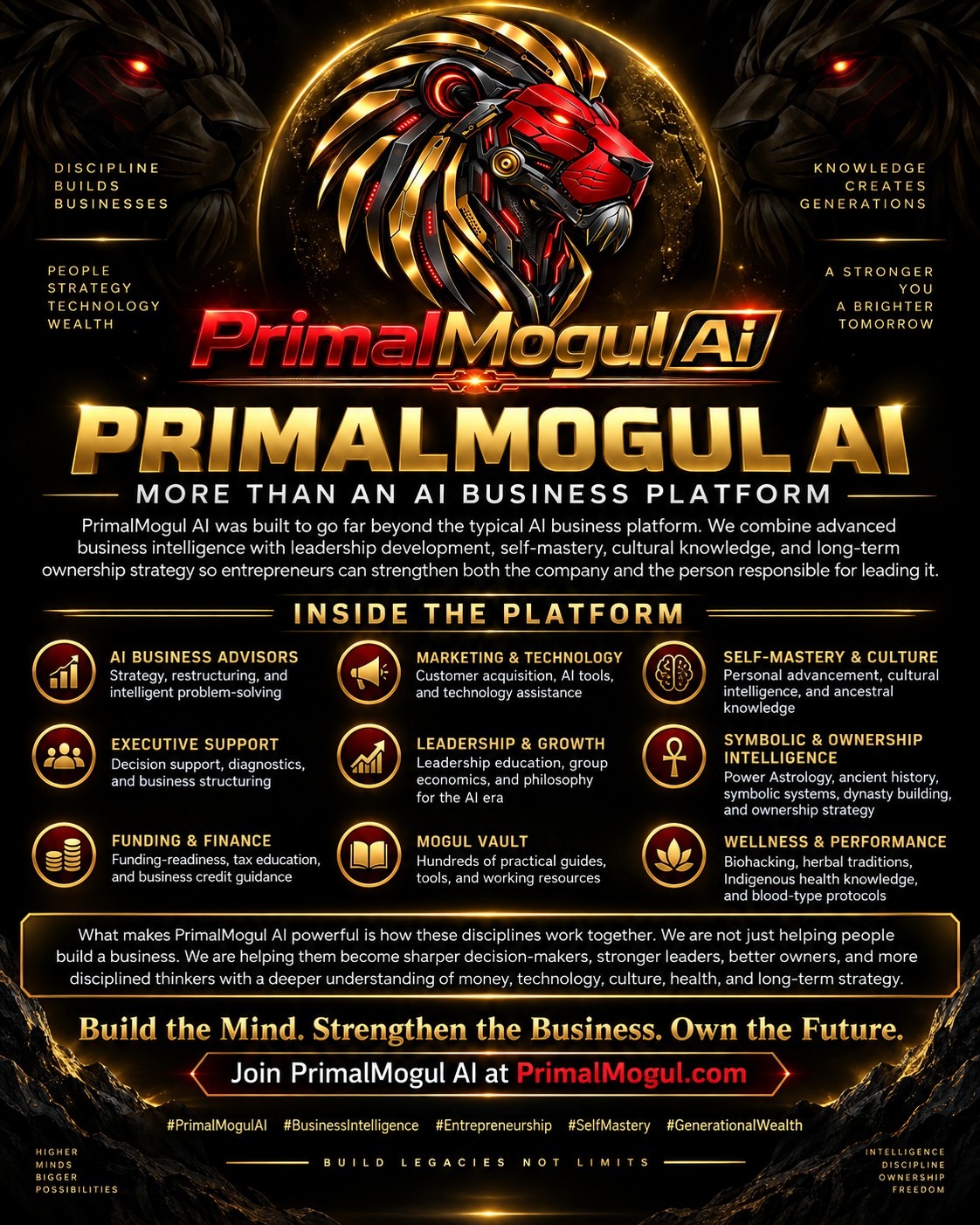
Reading the blueprint is the first step. Building on it is where the results come from. PrimalMogul AI gives solo founders the decision layer, revenue architecture, operator training, and intelligence tools described in this guide, organized into one connected platform instead of a scattered stack of software.
Membership turns the entire framework into a working system:
- A real decision-making layer. The BoardRoom Council of specialized AI advisors helps you diagnose your hardest problems before you commit time or money, so you act from analysis instead of impulse.
- A complete revenue and retention engine. Tiered membership, digital products, and the 600-plus resource Mogul Vault give your business more than one way to earn and a reason for customers to stay.
- Operator training that produces real skill. PrimalCourses AI, the Business Diagnostic, and the 7-Day Activation Path turn knowledge into demonstrated capability.
- Seven specialized intelligence tools in one ecosystem. PrimalMogul AI, Chairman AI, PrimalImage AI, PrimalTech AI, PrimalWealth AI, PrimalBroker AI, and PrimalCourses AI give one operator the coordinated power of a full team.
Core Builds. Elite Expands. BoardRoom Commands. Choose the level that matches where your business stands today, enter the command center, and start running your AI company on real structure.
Step inside. Take control. Move like a Primal Mogul.