
The Secret United Black Culture And Economics of Southern California
A teaching from PrimalMogul AI founder Jamal “Sultan” Leigh for the families, founders, and leaders building what their ancestors were locked out of, across the most powerful Black economic corridor in the American West.
Drive from Leimert Park east toward the Inland Empire and something becomes clear before you reach the county line. The Black presence in Southern California is not a neighborhood. It is not a single zip code, a single church row, or a single boulevard.
Across Los Angeles, San Bernardino, and Riverside counties, more than one million Black residents form a population corridor larger than the entire city of San Jose, spread across coastal cultural centers, inland family communities, and everything in between.
Million Black People is Not a Small Community
A million people is a nation inside a region. And nations do not survive on culture alone. They survive on ownership, on land, on capital, on infrastructure, and on the discipline to build systems that outlast the people who started them.
That is the conversation this piece exists to start. Not whether Black Southern California has influence, because that question was answered generations ago by the music, the language, the style, and the energy this region has exported to the entire planet.
The real question is whether that influence will finally be converted into ownership during the most important economic transition of our lifetimes, the age of artificial intelligence.
The window is open right now. What follows is the blueprint.
The Hidden Power Nobody Is Counting
Most analysts look at Black Southern California and see scattered populations across three large counties. They miss the corridor.
Layered together, the numbers tell a different story than the headlines:
- Los Angeles County holds roughly 750,000 to 860,000 Black-alone residents, the historic cultural and institutional core of Black California.
- San Bernardino County holds approximately 172,000 to 206,000 Black-alone residents, the fastest-rising inland family corridor in the region.
- Riverside County adds another 160,000 to 175,000 Black-alone residents, completing the eastern flank of the Inland Empire.
Combined, the three-county corridor exceeds one million Black residents using current estimates. That figure does not even count the broader Black population, those who identify as Black in combination with another race, or Black Latino residents who move fluidly across both cultural worlds. Add those communities and the true number climbs higher still.
Why the Corridor Matters More Than the Count
Here is what makes this a kingdom rather than a census statistic. The dollars flowing through this corridor, including wages, business revenue, entertainment income, athletic contracts, church tithes, and consumer spending, represent tens of billions annually.
The cultural exports produced here shape global fashion, music, film, sports, and language. Yet the ownership of the infrastructure that monetizes all of it has historically belonged to others.
That gap between cultural production and economic ownership is the single most important problem of Black Southern California. And it is solvable.
Why the AI Era Changes Everything
Every previous economic transition arrived with the gates already locked. The industrial age, the corporate age, the technology age, each one matured before most Black families were allowed meaningful entry, which meant playing catch-up against people who built the rules.
The AI transition is different in one specific way that matters enormously. The AI tools are available now, early, and cheaply, to anyone disciplined enough to learn them.
A solo entrepreneur in Compton has access to the same foundational AI capabilities as a venture-backed startup in Palo Alto. The barrier is no longer access to the technology. The barrier is knowing what to build and having the structure to build it well.
The First Ground-Floor Entry in History
This is the first economic transition in American history where Black Southern California can enter at the ground floor rather than the basement. But ground-floor entry only matters if it is organized.
A million people moving in a thousand uncoordinated directions produce noise. A million people moving along a shared economic blueprint produce a kingdom.
The frameworks below are how the corridor gets organized.
The Strategic Capitals: Defining the Network
A unified economic ecosystem requires designated centers, each with a defined role. Cities are not interchangeable. Each one carries a specific history, a specific asset base, and a specific function within the larger network.
Assigning roles prevents the scattered competition that has historically weakened Black economic efforts and replaces it with coordinated specialization.
Here is how the capitals divide the work.
Los Angeles, The Cultural and Media Throne
The historic heart remains the throne. South LA, Leimert Park, and the surrounding districts hold the deepest concentration of Black cultural institutions, media access, and creative talent anywhere in the West.
Los Angeles serves as the corridor’s content, media, and cultural production capital, the place where stories are told, brands are launched, and the cultural narrative is authored rather than borrowed.
Inglewood, The Entertainment and Sports Nexus
With the stadium economy, the arena, and the entertainment district now anchoring the city, Inglewood becomes the sports and live-entertainment capital.
The role here is to convert proximity to billion-dollar venues into Black ownership of the businesses that surround them, including hospitality, media production, real estate, and the service economies that orbit major events.
Ladera Heights, The Wealth and Family-Office Capital
Long known as one of the most affluent Black communities in America, Ladera Heights serves a different function, the wealth-preservation and family-office center.
This is where high-net-worth families anchor the capital infrastructure, including investment vehicles, generational planning, and the private financial architecture that turns income into lasting wealth.
Carson and Compton, The Trades, Logistics, and Manufacturing Core
Positioned near the ports and the industrial corridors, Carson and Compton form the foundational vehicle for economic sovereignty, which is trades, logistics, and physical production.
These are the cities where land, warehouses, transport, and skilled-trade businesses build the unglamorous but unshakable foundation that every real economy stands on.
Long Beach, The Port, Trade, and Maritime Gateway
With its port among the busiest in the nation, Long Beach anchors the corridor’s connection to global trade. The role is logistics ownership, import-export businesses, and the maritime and freight economy that moves physical goods through the region.
Pasadena, The Education, Technology, and Research Capital
Home to world-class research institutions, Pasadena serves as the knowledge and technology center, the place to build the AI talent pipeline, the research partnerships, and the educational infrastructure that supplies the entire corridor with skilled minds.
Riverside, The Eastern Education and Civic Anchor
As the largest city in its county and home to a major university, Riverside anchors the eastern flank with education, civic leadership, and the inland professional class. The role is workforce development and the cultivation of the next generation of inland Black professionals.
Rancho Cucamonga, The Inland Luxury and Residential Crown
Among the most prosperous and well-planned cities in the Inland Empire, Rancho Cucamonga becomes the inland luxury-residential capital, the destination for Black families building wealth through homeownership in a market still far more affordable than the coast. This is where the residential foundation of inland Black prosperity is planted.
How the Capitals Function as One System
Together, these capitals form a network rather than a scattering. Coastal cultural power flows inland. Inland affordability and family stability flow back toward the coast. Capital circulates rather than leaking out.
The Modern Black Wall Street: Five Pillars
The original Black Wall Street in Tulsa proved that a self-sustaining Black economy was possible. Its destruction proved that economic power without protection is fragile. A modern version must be built with both prosperity and durability in mind. The framework rests on five pillars.
AI Utility as the Great Equalizer
Every business in the corridor, from the barbershop to the law firm to the music label, adopts AI tools to compete at a level previously reserved for large corporations.
The corridor builds shared AI training infrastructure so that knowledge spreads horizontally rather than being hoarded. When a thousand small Black businesses each operate with the efficiency of a much larger company, the aggregate economic output transforms.
Cultural Heritage as Premium Brand Equity
The culture is not decoration. It is the most valuable export the corridor produces. The strategy is to own the monetization of that culture rather than licensing it cheaply to others.
This means Black-owned media platforms, Black-owned fashion houses, Black-owned music infrastructure, and Black-owned hospitality brands that command premium pricing because they own the cultural story rather than renting it.
Advanced Health Protocols as Longevity Infrastructure
A kingdom cannot prosper if its people are not well. The corridor must treat health as economic infrastructure, including preventive care, nutrition systems, mental wellness, and longevity protocols designed specifically for the community.
Healthy founders build longer. Healthy families accumulate wealth across more years. Health is not separate from wealth. It is the foundation that lets wealth compound.
High-Level Leadership and Governance
Scattered effort produces scattered results. The corridor needs coordinated leadership, including councils, alliances, and decision-making bodies that think across all three counties rather than competing within them.
Leadership here means the discipline to plan in decades, not news cycles, and the structure to hold the vision steady across changing conditions.
Land, Trades, and Logistics as the Foundation
Everything rests here. Culture inspires, AI accelerates, but land and physical infrastructure endure. The skilled trades, including construction, electrical, plumbing, HVAC, transport, and warehousing, are the foundation of economic sovereignty because they cannot be outsourced, cannot be automated away entirely, and produce the physical assets a community actually controls.
Land, Trades, and Logistics: The Foundation of Sovereignty
The temptation in the AI era is to chase only the digital. That instinct, left unchecked, would be a costly mistake for the corridor.
Physical infrastructure is what survives. The community that owns warehouses near the ports of Long Beach owns a piece of global trade.
A community that controls construction and skilled-trade businesses across the Inland Empire owns the literal building of the region. Communities that holds land in appreciating inland markets owns the ground future generations will stand on.
Why the Trades Deserve New Respect
The trades deserve special honor here, because they have been quietly undervalued for too long. Which includes skilled electricians, master plumbers, logistics company owners, and commercial contractors.
These are the people who build durable wealth that does not evaporate when a trend passes. The corridor should treat the trades not as a fallback but as a primary path to ownership.
Consider the structure of what becomes possible:
- Black-owned logistics firms moving goods through Long Beach and the inland distribution corridors
- Black-owned construction and trade companies building the residential and commercial growth of the Inland Empire
- Black-owned land holdings in Rancho Cucamonga, Riverside, and the surrounding inland markets, acquired while prices remain reachable
- Black-owned warehousing and last-mile delivery infrastructure serving the e-commerce economy
- Trade apprenticeship programs that move young people from uncertainty into six-figure skilled careers
This is the foundation. AI sits on top of it. Culture markets it. But land and trades are the bedrock foundation.

Solving the Hard Problems: Poverty and Safety
No honest blueprint for Black Southern California can skip the two challenges that determine whether families stay or leave, which are economic hardship and community safety. Prosperity that does not reach the struggling is not sovereignty. It is a gated subdivision inside a larger crisis.
The corridor must address both directly.
A Real Strategy for Poverty Reduction
On poverty reduction, the strategy is pathways, not handouts. The most durable anti-poverty engine is ownership and skilled employment. Practical moves include:
- Trade apprenticeship pipelines that move young people from minimum-wage work into skilled careers earning multiples more
- AI upskilling programs in community centers and churches, teaching practical income-generating skills at low or no cost
- Community investment funds that pool capital to support Black business formation, modeled on the group-economics traditions that built earlier Black prosperity
- Homeownership assistance focused on the affordable inland markets, where families can still build equity
Connecting Safety to Economic Belonging
On community safety, the strategy connects directly to economics. Safe communities are communities where people have something to protect and somewhere to belong.
Practical moves include:
- Business-district investment that brings consistent legitimate activity, jobs, and foot traffic to corridors that have been neglected
- Youth programs tied to real economic pathways, giving young people a visible future worth choosing
- Community ownership of local commercial real estate, so the businesses on the block answer to the neighborhood rather than to absentee owners
- Reentry and second-chance employment programs through Black-owned trade and logistics companies
Safety and prosperity are not separate projects. They are the same project viewed from two angles.
The Role of High-Net-Worth Contributors
Southern California holds an extraordinary concentration of wealthy Black individuals, including professional athletes, entertainers, business owners, and executives.
Too often that wealth flows outward, into ventures and regions that have nothing to do with the communities that produced these individuals. Redirecting even a fraction of that capital inward would transform the corridor.
Investment Over Charity
The contribution must be structured, not charitable. Charity creates dependence. Investment creates infrastructure. Here is how high-net-worth individuals can build the kingdom rather than merely donate to it:
- Athletes can anchor real estate funds that acquire commercial property and land across the corridor, building appreciating assets while creating community-owned business districts.
- Entertainers can own the media and production infrastructure in Los Angeles and Inglewood, ensuring the culture is monetized by the people who create it rather than extracted by outside platforms.
- Business magnates can seed and mentor the next generation of founders, providing both capital and the hard-won knowledge that capital alone cannot buy.
- All three groups can pool capital into a corridor-wide investment vehicle, a family-office network anchored in Ladera Heights, that thinks across decades and treats Black Southern California as a long-term asset class worth building.
The model here is patient capital deployed with intelligence. The wealthy contributor is not a donor. The wealthy contributor is an anchor investor in the most promising economic corridor in the American West.
The Synthesis: A Luxury, Sovereign Ecosystem
Pull every thread together and the vision becomes clear. The United Black Kingdoms of SoCal is a coordinated, luxury-oriented, sovereign economic and cultural ecosystem spanning three counties and more than a million people.
It is luxury-oriented because the culture commands premium value and should be priced accordingly rather than discounted. It’s sovereign because it rests on owned land, owned infrastructure, owned media, and owned capital rather than borrowed access. And it is an ecosystem because every part feeds every other part.
Culture drives demand, AI drives efficiency, trades build the foundation, capital circulates internally, and leadership holds the long-term vision steady.
The Intense Will to Build
These counties already produces the talent, the culture, the energy, and the consumer power. What it has lacked is coordination and ownership. The AI era provides the tools. This blueprint provides the structure. The million people provide the force.
What remains is the will to build.
Raw Receipts and Records
The vision above rests on documented reality, not aspiration.
The three-county Black population corridor is real and measurable. Los Angeles County’s Black-alone population sits between roughly 750,000 and 860,000 depending on the measurement, per ACS and Census QuickFacts data.
San Bernardino County adds approximately 172,000 to 206,000, and Riverside County contributes another 160,000 to 175,000 based on 2024 ACS and Census estimates, a combined corridor exceeding one million residents. The inland affordability gap is documented.
Los Angeles County’s median owner-occupied home value reached $866,500 in recent ACS data, while San Bernardino sat at $545,900 and Riverside near $510,000, explaining the family migration toward the Inland Empire and the homeownership opportunity inland markets present.
The Great Migration foundation is historical fact
The National Archives documents the movement of roughly six million Black Americans from the South between 1910 and 1970, and PBS SoCal confirms that World War II defense production drove a major Black migration specifically into Los Angeles, building the institutional base that still anchors so-cal.
The Inland Empire growth pattern is confirmed by county data. San Bernardino County’s own indicators show a younger median age and lower housing costs than Los Angeles, with Black population share projected to increase through 2045, confirming the inland corridor as a genuine growth region rather than a temporary overflow.
The AI accessibility shift is real and present. Foundational AI tools that once required corporate budgets are now available to individual entrepreneurs at low cost, marking the first major economic transition where ground-floor entry is genuinely available to communities historically locked out.
The Move From Here
Here is your specific action for the next 24 hours.
Pull up a map of the three-county corridor. Identify which of the strategic capitals is closest to where you live or do business.
Then write down one specific way your work, your skills, or your capital connects to that city’s defined role in the network, whether that is media in Los Angeles, trades in Carson, logistics in Long Beach, or land in Rancho Cucamonga.
Knowing your position in the kingdom is the first step to building your part of it. Write it down today. Build from it tomorrow.
The Real Lesson
A million people is not a minority. A million people coordinated around shared ownership is a sovereign economic force. The difference between those two realities is not population, money, or talent, because Black Southern California already holds all three in abundance.
The original Black Wall Street was destroyed because prosperity was built without sufficient power to protect it. The modern version must be built with both. The land, the trades, the logistics, and the capital form the protected foundation. The culture, the AI, and the leadership form the engine that compounds it.
The ancestors who migrated west during the wartime decades came chasing a future they could not fully claim in their own lifetimes. The corridor they built is now positioned to claim it. The tools exist. The people are here. The blueprint is written.
The kingdom is waiting to be built. The only remaining question is who shows up to build it.
FAQ’s: The Secret Black Nation in Southern California
Is a unified three-county Black economic corridor actually realistic, or is this just an idea?
The population, the capital, and the cultural production already exist, and those are not aspirational, they are documented. What does not yet exist is the coordination layer that connects them.
Building that layer is realistic precisely because the hard ingredients are already present. The challenge is organizational, not material, which makes it far more achievable than starting from nothing.
Why emphasize trades and logistics when the AI economy is the future?
Because durable wealth rests on assets that cannot be easily taken or automated away. AI accelerates a business, but land, warehouses, skilled-trade companies, and logistics infrastructure are physical holdings a community actually controls.
The smartest strategy pairs both, with AI efficiency layered on top of a physical-asset foundation. One without the other is incomplete.
How can someone with limited capital participate in this vision?
Through skills and ownership rather than large investment. Learning a high-income trade, mastering AI tools to start a service business, joining or forming a community investment pool, or buying property in an affordable inland market are all entry points that do not require existing wealth.
The corridor is built by thousands of individual moves, not only by large investors.
What makes the Inland Empire so important to this strategy?
Affordability and growth. While coastal Los Angeles has become difficult for families to own in, the Inland Empire, including Riverside, San Bernardino, and Rancho Cucamonga, still offers reachable home prices and appreciating land.
That makes it the residential and ownership foundation of the corridor, where families can build the equity that funds everything else.
How do high-net-worth athletes and entertainers actually help beyond donations?
By becoming anchor investors rather than donors. An athlete who anchors a real estate fund, an entertainer who owns media infrastructure, or a magnate who seeds new founders builds permanent assets that keep producing value long after a single donation would have been spent. Structured investment compounds. Charity does not.
Does focusing on Black economic ownership exclude other communities?
Building strength within a community is not the same as excluding others. The corridor described here participates in the broader Southern California economy and trades with everyone.
Strong, self-sustaining communities make better partners, better neighbors, and better contributors to the wider region. Sovereignty enables healthy collaboration rather than preventing it.
Where does PrimalMogul AI fit into a vision this large?
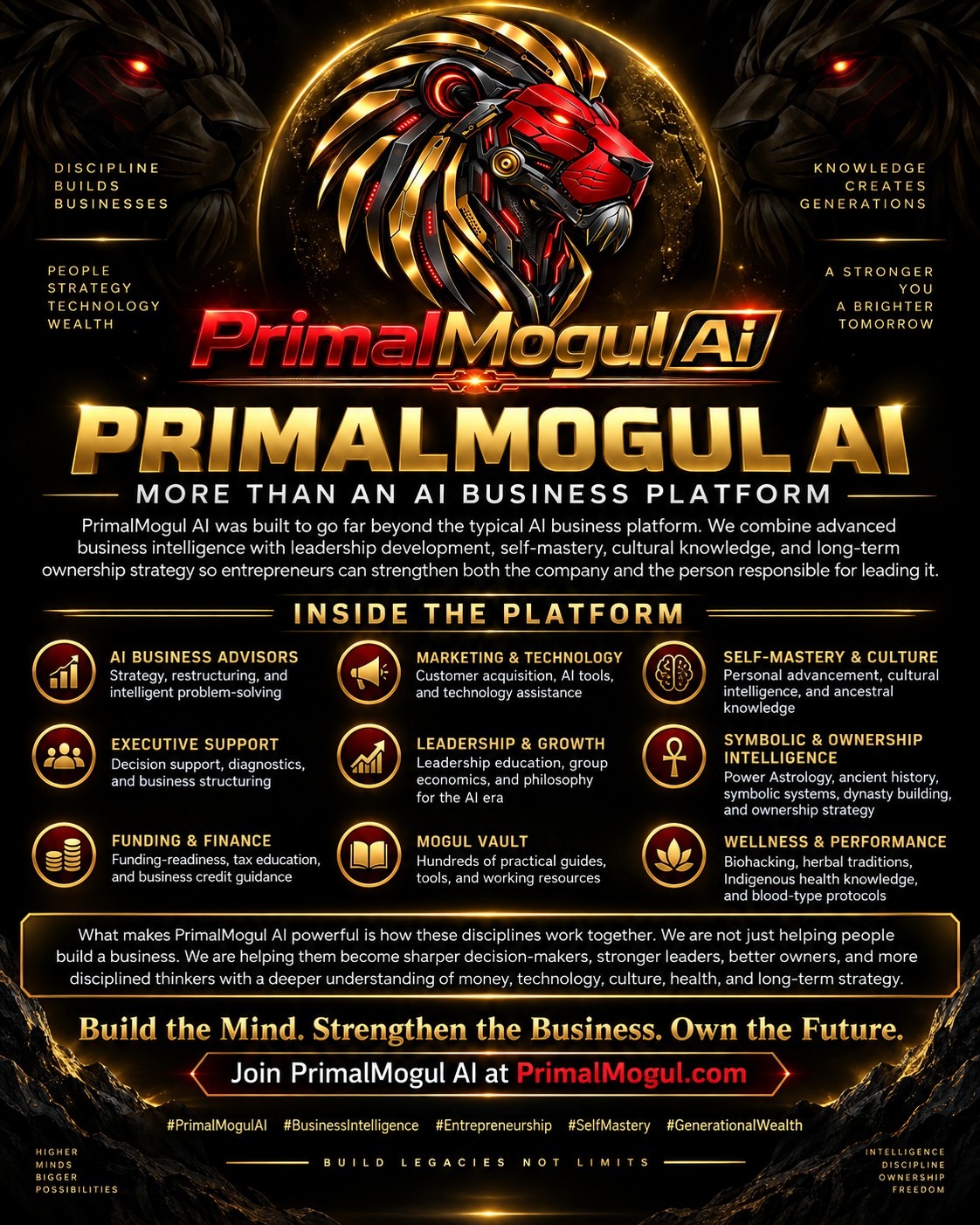
PrimalMogul AI provides the business intelligence layer that individual founders and families need to participate in the corridor effectively.
Whether someone is starting a trade business, launching a media brand, preparing for funding, or building an AI service company, the platform gives them the training, tools, and structure to build it well.
A kingdom is built by prepared individuals, and preparation is exactly what the platform delivers.
Join the Kingdom: Build Your Part of the Mission
The vision is large, but it gets built one prepared founder at a time. PrimalMogul AI gives you the training, the AI tools, and the business structure to claim your role in the most powerful Black economic corridor in the American West.
Here is what membership gives you relative to everything in this piece:
- AI training paths that teach you how to use artificial intelligence to compete at a level once reserved for large corporations
- Funding readiness systems that prepare you to acquire the land, trades businesses, and commercial property that form the foundation of sovereignty
- The PrimalBroker AI tool built specifically for the real estate and mortgage professionals who will drive Inland Empire homeownership and land acquisition
- Business intelligence training that turns scattered ambition into a coordinated, structured operating plan
- The Mogul Vault filled with case studies, frameworks, and guides on building Black wealth and cultural ownership
- The Executive AI Council for the high-level decisions involving capital, growth, and long-range strategy
Step inside. Take control. Command your business empire.